Abstract
Living organisms have evolved a plethora of sensing systems for the intra- and extracellular detection of small molecules, ions or physical parameters. Several recent studies have demonstrated that these principles can be exploited to devise synthetic regulatory circuits for metabolic engineering strategies. In this context, transcription factors (TFs) controlling microbial physiology at the level of transcription play a major role in biosensor design, since they can be implemented in synthetic circuits controlling gene expression in dependency of, for example, small molecule production. Here, we review recent progress on the utilization of TF-based biosensors in microbial biotechnology highlighting different areas of application. Recent advances in metabolic engineering reveal TF-based sensors to be versatile tools for strain and enzyme development using high-throughput (HT) screening strategies and adaptive laboratory evolution, the optimization of heterologous pathways via the implementation of dynamic control circuits and for the monitoring of single-cell productivity in live cell imaging studies. These examples underline the immense potential of TF-based biosensor circuits but also identify limitations and room for further optimization.
🔬 Techniques
🧬 Organisms
✨ Fluorophores
🧪 Sample Preparation
🔬 Cell Lines
🧪 Reagent Suppliers
🏛️ Research Organizations (ROR)
Affiliated research institutions:
📊 Figures
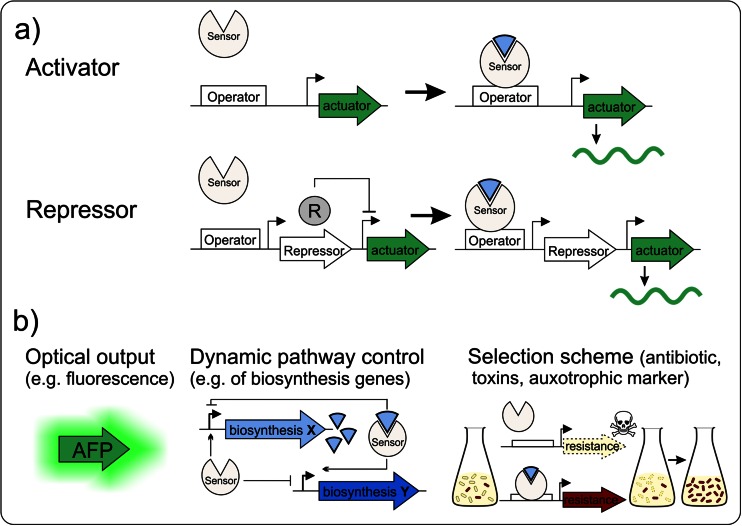
Fig. 1
Principles for the architecture of transcription factor-based biosensors. a A transcriptional activator may be used to activate expression of an actuator gene (circuit) in response to effector molecul...
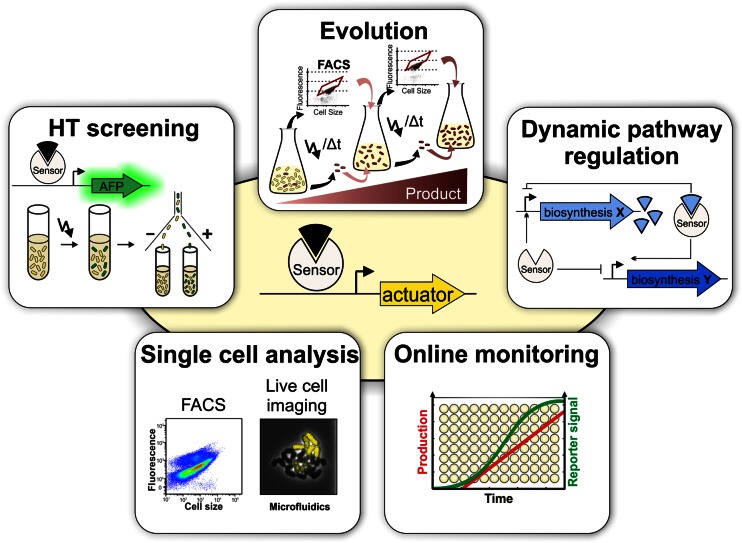
Fig. 2
Versatile applications of TF-based biosensors. Biosensors with an optical readout, e.g. production of an autofluorescent protein ( AFP ), are efficient tools for the high-throughput ( HT ) screening o...
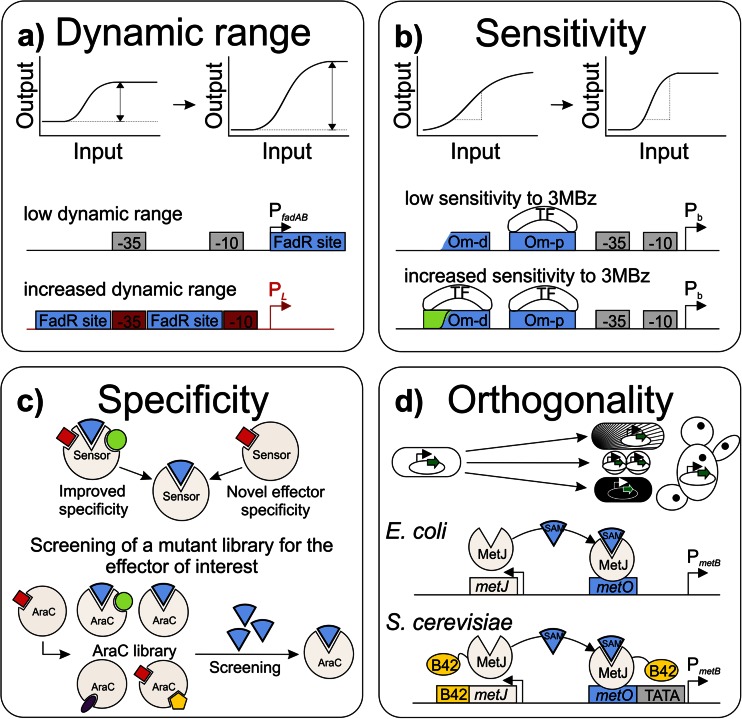
Fig. 3
Examples of biosensor engineering for altered performance characteristics or orthogonal applications. a The dynamic range, describing the maximum fold change of a reporter output to a given input sign...
Figure images are served from the NIH/NLM PubMed Central Open Access Subset or Europe PMC; copyright remains with the publishers and authors.
💬 Discussion
0 commentsNo comments yet. Be the first to start a discussion!
Leave a Comment