Abstract
Natural fiber as reinforcement filler in polymer composites is an attractive approach due to being fully biodegradable and cheap. However, incompatibility between hydrophilic natural fiber and hydrophobic polymer matrix restricts the application. The current studies focus on the effects of incorporation of silane treated OPMF into polylactic acid (PLA)/polycaprolactone (PCL)/nanoclay/OPMF hybrid composites. The composites were prepared by melt blending technique and characterize the composites with Fourier transform infrared spectroscopy (FTIR), thermogravimetric analysis (TGA), and scanning electron microscopy (SEM). FTIR spectra indicated that peak shifting occurs when silane treated OPMF was incorporated into hybrid composites. Based on mechanical properties results, incorporation of silane treated OPMF enhances the mechanical properties of unmodified OPMF hybrid composites with the enhancement of flexural and impact strength being 17.60% and 48.43%, respectively, at 10% fiber loading. TGA thermogram shows that incorporation of silane treated OPMF did not show increment in thermal properties of hybrid composites. SEM micrographs revealed that silane treated OPMF hybrid composites show good fiber/matrix adhesion as fiber is still embedded in the matrix and no cavity is present on the surface. Water absorption test shows that addition of less hydrophilic silane treated OPMF successfully reduces the water uptake of hybrid composites.
🔬 Techniques
✨ Fluorophores
🏭 Microscope Brands
🧪 Reagent Suppliers
🏛️ Research Organizations (ROR)
Affiliated research institutions:
📋 Methods
2. Experimental 2.1. Materials All reactions were carried out by using reagent grade chemicals (>98% purity) without further purification. The hydrophilic nanoclay (Nonamer PGV) was purchased from Sigma-Aldrich and used as received. Polylactide Resin 4060D was supplied by NatureWorks while Polycaprolactone (CAPA 650) was supplied by Solvay Caprolactone. Oil palm mesocarp fibers were obtained from Felda Palm Ind. Sdn Bhd., Serting Hilir, Negeri Sembilan, Malaysia. 3-(Trimethoxysilyl)propyl methacrylate was purchased from Acros Organic. 2.2.
Processing of Raw OPMF
The raw OPMF fiber was soaked in distilled water for 24 h to remove impurities. It was then rinsed with hot water (60°C) twice and finally with acetone to remove wax prior to drying at 60°C in an air oven. The fiber was ground and sieved to a particle size of 150 μ m using a crusher machine. 2.3. Modification of OPMF by Methacrylate Silane 5 wt% of silane (weight percentage compared to the OPMF) was dissolved for hydrolysis in a mixture of 3 : 2 ratio of ethanol and water. The PH of the solution was adjusted to 4 with acetic acid and stirred continuously for 1 hour. The unbleached or bleached OPMF were soaked in the solution for 3 hours and then dried at 60°C in air oven overnight. 2.4.
Preparation of Hybrid Composites
The composites were prepared by melt blending technique where the compositions of PLA and PCL were kept constant at 85 wt% and 15 wt%, respectively, in blend while the clay content constant was kept at 1 wt%. Only the content of OPMF (unmodified and silane treated) varies from 0% to 30%. The formulation table was shown in Table 1 . PLA, PCL, nanoclay, and OPMF were manually premixed in a container and fed into Brabender Plastograph EC at 170°C with rotor speed of 50 rpm for 10 minutes. The products were then compression moulded into sheets of 1 mm (for tensile properties) or 3 mm (for flexural properties and Izod impact resistance) thickness by an electrically heated hydraulic press with a force of 1500 kN at 160°C for 10 minutes. The sample sheets were then used for further characterization. 2.5. Fourier Transform Infrared Spectroscopy (FTIR) Perkin Elmer Spectrum 100 series spectrometer equipped with attenuated total reflectance (ATR) were used to determine the functional groups and types of the bonding of the samples with the infrared spectra were recorded in the range of frequency of 280 to 4000 cm −1 with the resolution of 4 cm −1 and the number of scans is 16 scans. 2.6. Tensile Properties Tensile properties measurement was performed by Instron machine model 4301, with grip attachment distance of 45 mm. Load of 1.0 kN was applied at constant crosshead speed of 5 mm min −1 . Computerized Instron (Software series 9, national instruments GPIB PC2/2a and NI-488.2) was used to process data. Test specimen was prepared and stamped in compliance with ASTM D638 dumbbell parameters. Sample thickness was measured with Mitutoyo Digimatic Indicator, type IDF-112, having measuring accuracy of ±0.001 mm. 2.7. Flexural Properties The flexural strength and modulus were measured with Instron Universal Testing Machine 4301 according to ASTM D790. The size of the samples testing is 127 mm × 12.7 mm × 3 mm. The crosshead speed is 1.3 mm/min and the support span length is 48 mm. Data was processed with computerized Instron (Software series 9, national instruments GPIB PC2/2a and NI-488.2). 2.8. Izod Impact Strength The Izod impact test was carried out according to ASTM D256 standard using an impact tester (IZOD Impact Tester). The sample size is 63.5 × 12.7 × 3 mm, while the notch length is 2.54 mm. The energy required to break the samples was divided by unit area of residual cross section of sample to obtain impact resistance value. The impact strength (J/m) was calculated by dividing the energy obtained (J) with the thickness of specimen (m). 2.9. Thermogravimetric Analysis (TGA) TGA testing was conducted in accordance with ASTM E1131. Perkin Elmer TGA7 was used for thermogravimetric analysis of samples where about 15 mg of the samples were heated from 35°C to 800°C with the heating rate of 10°C/min. Nitrogen gas was pumped with the flow rate of 20 mL/min in order to let the analysis be carried out in nitrogen atmosphere. 2.10. Scanning Electron Microscopy (SEM) The surface morphology of fracture surface was observed with SEM JEOL JSM-6400. The fracture surface was obtained from plain strain fracture tensile tested specimens and was sputter coated with gold using Bio-rad coating system before viewing. 2.11.
Show full methods section
2. Experimental 2.1. Materials All reactions were carried out by using reagent grade chemicals (>98% purity) without further purification. The hydrophilic nanoclay (Nonamer PGV) was purchased from Sigma-Aldrich and used as received. Polylactide Resin 4060D was supplied by NatureWorks while Polycaprolactone (CAPA 650) was supplied by Solvay Caprolactone. Oil palm mesocarp fibers were obtained from Felda Palm Ind. Sdn Bhd., Serting Hilir, Negeri Sembilan, Malaysia. 3-(Trimethoxysilyl)propyl methacrylate was purchased from Acros Organic. 2.2.
Processing of Raw OPMF
The raw OPMF fiber was soaked in distilled water for 24 h to remove impurities. It was then rinsed with hot water (60°C) twice and finally with acetone to remove wax prior to drying at 60°C in an air oven. The fiber was ground and sieved to a particle size of 150 μ m using a crusher machine. 2.3. Modification of OPMF by Methacrylate Silane 5 wt% of silane (weight percentage compared to the OPMF) was dissolved for hydrolysis in a mixture of 3 : 2 ratio of ethanol and water. The PH of the solution was adjusted to 4 with acetic acid and stirred continuously for 1 hour. The unbleached or bleached OPMF were soaked in the solution for 3 hours and then dried at 60°C in air oven overnight. 2.4.
Preparation of Hybrid Composites
The composites were prepared by melt blending technique where the compositions of PLA and PCL were kept constant at 85 wt% and 15 wt%, respectively, in blend while the clay content constant was kept at 1 wt%. Only the content of OPMF (unmodified and silane treated) varies from 0% to 30%. The formulation table was shown in Table 1 . PLA, PCL, nanoclay, and OPMF were manually premixed in a container and fed into Brabender Plastograph EC at 170°C with rotor speed of 50 rpm for 10 minutes. The products were then compression moulded into sheets of 1 mm (for tensile properties) or 3 mm (for flexural properties and Izod impact resistance) thickness by an electrically heated hydraulic press with a force of 1500 kN at 160°C for 10 minutes. The sample sheets were then used for further characterization. 2.5. Fourier Transform Infrared Spectroscopy (FTIR) Perkin Elmer Spectrum 100 series spectrometer equipped with attenuated total reflectance (ATR) were used to determine the functional groups and types of the bonding of the samples with the infrared spectra were recorded in the range of frequency of 280 to 4000 cm −1 with the resolution of 4 cm −1 and the number of scans is 16 scans. 2.6. Tensile Properties Tensile properties measurement was performed by Instron machine model 4301, with grip attachment distance of 45 mm. Load of 1.0 kN was applied at constant crosshead speed of 5 mm min −1 . Computerized Instron (Software series 9, national instruments GPIB PC2/2a and NI-488.2) was used to process data. Test specimen was prepared and stamped in compliance with ASTM D638 dumbbell parameters. Sample thickness was measured with Mitutoyo Digimatic Indicator, type IDF-112, having measuring accuracy of ±0.001 mm. 2.7. Flexural Properties The flexural strength and modulus were measured with Instron Universal Testing Machine 4301 according to ASTM D790. The size of the samples testing is 127 mm × 12.7 mm × 3 mm. The crosshead speed is 1.3 mm/min and the support span length is 48 mm. Data was processed with computerized Instron (Software series 9, national instruments GPIB PC2/2a and NI-488.2). 2.8. Izod Impact Strength The Izod impact test was carried out according to ASTM D256 standard using an impact tester (IZOD Impact Tester). The sample size is 63.5 × 12.7 × 3 mm, while the notch length is 2.54 mm. The energy required to break the samples was divided by unit area of residual cross section of sample to obtain impact resistance value. The impact strength (J/m) was calculated by dividing the energy obtained (J) with the thickness of specimen (m). 2.9. Thermogravimetric Analysis (TGA) TGA testing was conducted in accordance with ASTM E1131. Perkin Elmer TGA7 was used for thermogravimetric analysis of samples where about 15 mg of the samples were heated from 35°C to 800°C with the heating rate of 10°C/min. Nitrogen gas was pumped with the flow rate of 20 mL/min in order to let the analysis be carried out in nitrogen atmosphere. 2.10. Scanning Electron Microscopy (SEM) The surface morphology of fracture surface was observed with SEM JEOL JSM-6400. The fracture surface was obtained from plain strain fracture tensile tested specimens and was sputter coated with gold using Bio-rad coating system before viewing. 2.11.
Water Sorption Test
Water absorption studies were performed following the ASTM D638, Type M3 standard. The films were cut into dumbbell shape and dried at room temperature overnight to reach the constant weight. Then the samples were immersed at 25°C of distilled water for up to 30 days. Mass uptakes of the samples were measured periodically by removing them from the water bath. The samples were wiped with the tissue paper to remove the surface water. The moisture uptake expressed in percent weight gain, Δ M , is (1) Δ M = M t − M o M o × 100 % , where M t is mass of sample after immersion and M o is mass of sample before immersion.
2.1. Materials All reactions were carried out by using reagent grade chemicals (>98% purity) without further purification. The hydrophilic nanoclay (Nonamer PGV) was purchased from Sigma-Aldrich and used as received. Polylactide Resin 4060D was supplied by NatureWorks while Polycaprolactone (CAPA 650) was supplied by Solvay Caprolactone. Oil palm mesocarp fibers were obtained from Felda Palm Ind. Sdn Bhd., Serting Hilir, Negeri Sembilan, Malaysia. 3-(Trimethoxysilyl)propyl methacrylate was purchased from Acros Organic.
📊 Figures
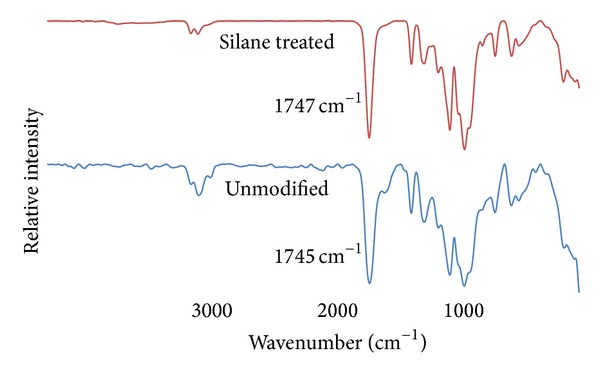
Figure 1
FTIR spectra of unmodified and silane treated OPMF hybrid composites.
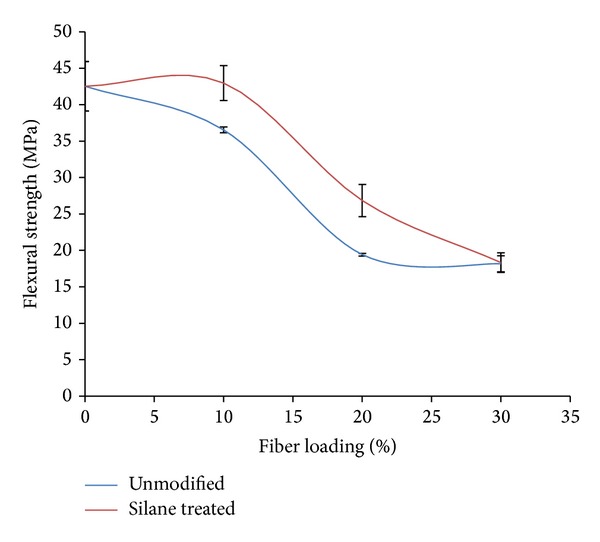
Figure 2
Flexural strength of unmodified and silane treated OPMF hybrid composites.
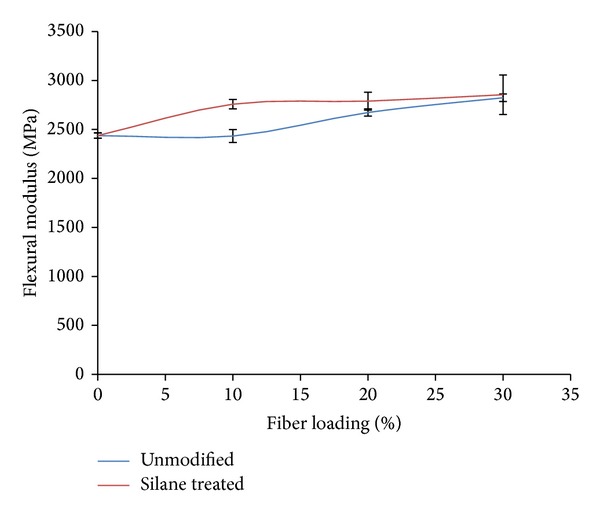
Figure 3
Flexural modulus of unmodified and silane treated OPMF hybrid composites.
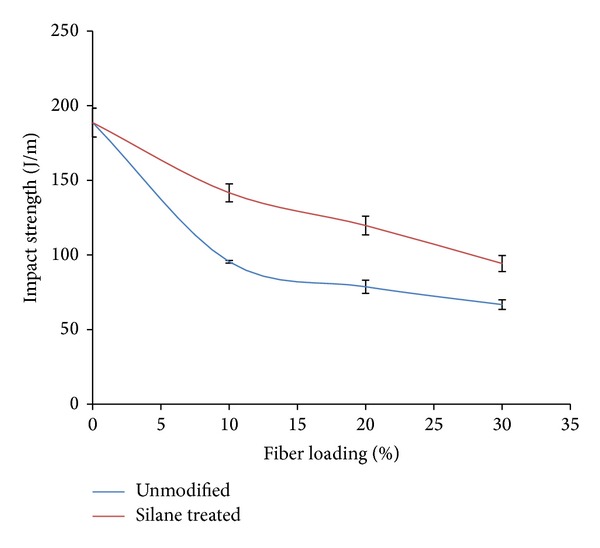
Figure 4
Impact strength of unmodified and silane treated OPMF hybrid composites.
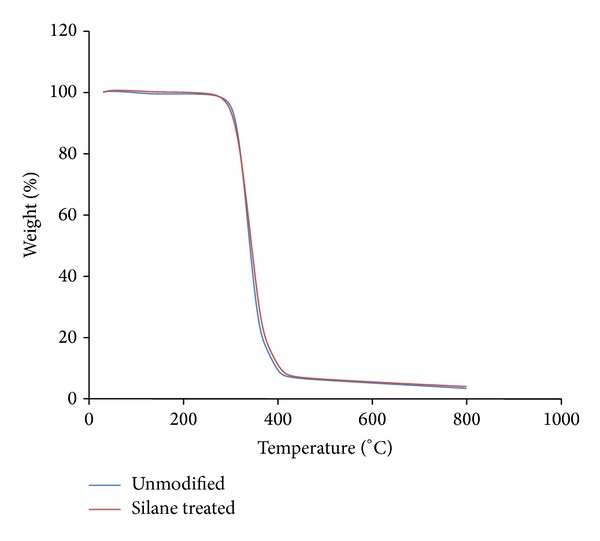
Figure 5
TG thermogram of unmodified and silane treated OPMF hybrid composites.
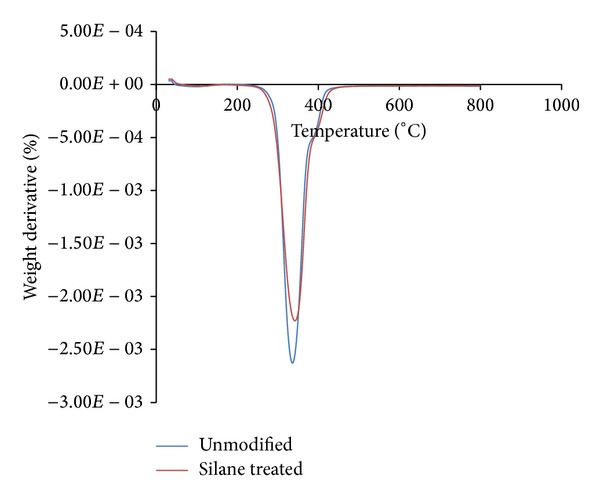
Figure 6
DTG thermogram of unmodified and silane treated OPMF hybrid composites.
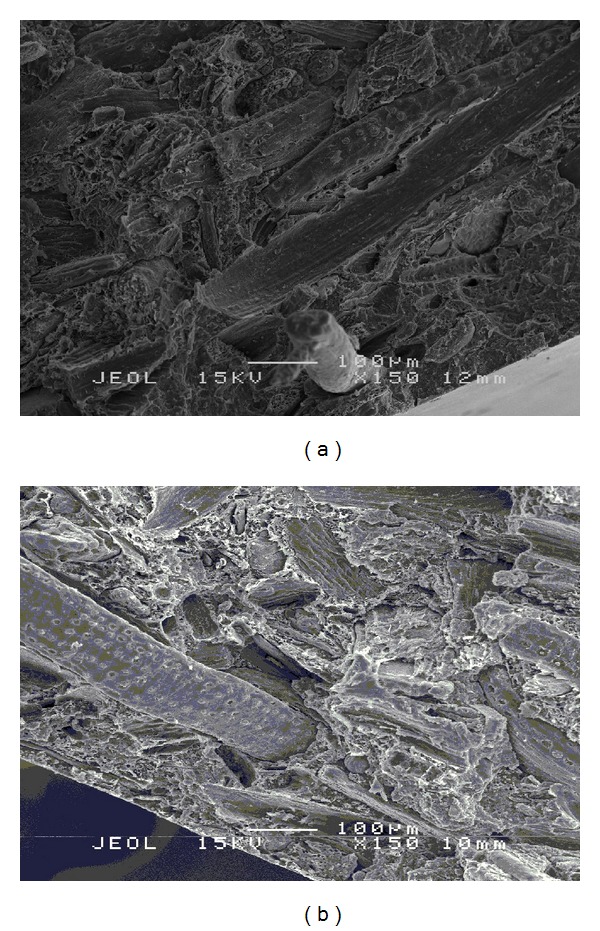
Figure 7
SEM micrograph of (a) unmodified and (b) silane treated OPMF hybrid composites.
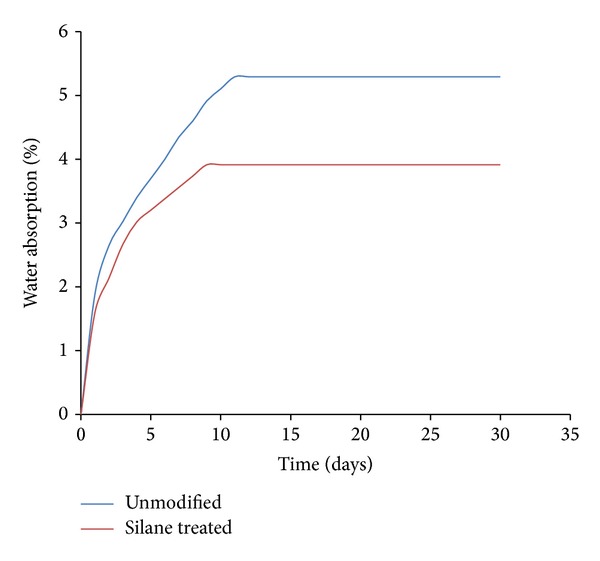
Figure 8
Water absorption of unmodified and silane treated OPMF hybrid composites.
Figure images are served from the NIH/NLM PubMed Central Open Access Subset or Europe PMC; copyright remains with the publishers and authors.
💬 Discussion
0 commentsNo comments yet. Be the first to start a discussion!
Leave a Comment