Abstract
Despite the use of anti-retroviral therapies, a majority of HIV-infected individuals still develop HIV-Associated Neurocognitive Disorders (HAND), indicating that host inflammatory mediators, in addition to viral proteins, may be contributing to these disorders. Consistently, we have previously shown that levels of the inflammatory mediator soluble CD40L (sCD40L) are elevated in the circulation of HIV-infected, cognitively impaired individuals as compared to their infected, non-impaired counterparts. Recent studies from our group suggest a role for the CD40/CD40L dyad in blood brain barrier (BBB) permeability and interestingly, sCD40L is thought to regulate BBB permeability in other inflammatory disorders of the CNS. Using complementary multiphoton microscopy and quantitative analyses in wild-type and CD40L deficient mice, we now reveal that the HIV transactivator of transcription (Tat) can induce BBB permeability in a CD40L-dependent manner. This permeability of the BBB was found to be the result of aberrant platelet activation induced by Tat, since depletion of platelets prior to treatment reversed Tat-induced BBB permeability. Furthermore, Tat treatment led to an increase in granulocyte antigen 1 (Gr1) positive monocytes, indicating an expansion of the inflammatory subset of cells in these mice, which were found to adhere more readily to the brain microvasculature in Tat treated animals. Exploring the mechanisms by which the BBB becomes compromised during HIV infection has the potential to reveal novel therapeutic targets, thereby aiding in the development of adjunct therapies for the management of HAND, which are currently lacking.
🔬 Techniques
✨ Fluorophores
🔬 Cell Lines
🏭 Microscope Brands
🧪 Reagent Suppliers
🔴 Lasers
🏛️ Research Organizations (ROR)
Affiliated research institutions:
📋 Methods
Ethics Statement
All experiments involving the use of laboratory animals were carried out in accordance with the Animal Welfare Act and the National Institute of Health (NIH) guidelines, and the animal protocol was approved by the University Committee on Animal Resources of the University of Rochester Medical Center. The facilities and programs of the Vivarium and Division of Laboratory Animal Medicine of the School of Medicine and Dentistry are fully accredited by the Association for the Assessment and Accreditation of Laboratory Animal Care International (AAALAC) and are in compliance with state law, federal statute, and NIH policy. All animals used in these studies, strains C57BL/6 and B6.129s2-CD40lg tm1Imx /J, were purchased from The Jackson Laboratory, Bar Harbor, ME. Reagents and Antibodies HIV Tat 1–72 was obtained from Dr. Avindra Nath (National Institute of Neurological Disorders and Stroke, Baltimore, MD) and Philip Ray (University of Kentucky, Lexington, KY). Production of this protein has been described previously [23] – [25] and the purified protein was found to be >98% pure, with less than 1 pg/mg endotoxin content of Tat protein [23] – [25] . We have also tested the effects of heat inactivated Tat (H.I. Tat) that was prepared in the same manner, but subsequently incubated at 85°C for 30 minutes, as previously described [26] , [27] , as this allows a control for nonspecific contaminants that may arise during production and processing of the protein. We found no significant differences between treatment with H.I. Tat and saline controls, and therefore, in some cases saline controls alone are displayed. It should also be noted that when working with Tat all instruments were siliconized with Sigmacote (Sigma-Aldrich, St. Louis, MO) to avoid loss of the reagent. Fluorescein sodium salt was purchased from Sigma-Aldrich (St. Louis, MO); recombinant mouse CD40L was purchased from R&D Systems (Minneapolis, MN). Antibodies against mouse granulocyte antigen 1 (Gr1; also known as Ly-6C/G) conjugated to Alexa Fluor 488, and Texas Red Dextran were obtained from Invitrogen (Carlsbad, CA), while phycoerythrin-conjugated anti-mouse CCR-2 was purchased from R&D Systems (Minneapolis, MN). Antibodies for platelet depletion, as well as non-immune rat immunoglobulin control antibodies, were purchased from Emfret Analytics (Eibelstadt, Germany). ELISA Ten to twelve-week old wild-type C57BL/6 (WT) mice (n = 5 for each group) were injected retro-orbitally with HIV Tat (100 ng/g body weight). One-hour post-injection, whole blood was collected via cardiac exsanguination and sequentially centrifuged to obtain platelet poor plasma (PPP). Soluble CD40L or platelet factor 4 (PF4) concentrations were measured in PPP samples using either a mouse sCD40L or PF4 ELISA kit (R&D Systems, Minneapolis, MN) according to the manufacturer’s protocol. Samples were compared using an unpaired t-test with statistical significance indicated in the figure as **p
Show full methods section
Ethics Statement
All experiments involving the use of laboratory animals were carried out in accordance with the Animal Welfare Act and the National Institute of Health (NIH) guidelines, and the animal protocol was approved by the University Committee on Animal Resources of the University of Rochester Medical Center. The facilities and programs of the Vivarium and Division of Laboratory Animal Medicine of the School of Medicine and Dentistry are fully accredited by the Association for the Assessment and Accreditation of Laboratory Animal Care International (AAALAC) and are in compliance with state law, federal statute, and NIH policy. All animals used in these studies, strains C57BL/6 and B6.129s2-CD40lg tm1Imx /J, were purchased from The Jackson Laboratory, Bar Harbor, ME. Reagents and Antibodies HIV Tat 1–72 was obtained from Dr. Avindra Nath (National Institute of Neurological Disorders and Stroke, Baltimore, MD) and Philip Ray (University of Kentucky, Lexington, KY). Production of this protein has been described previously [23] – [25] and the purified protein was found to be >98% pure, with less than 1 pg/mg endotoxin content of Tat protein [23] – [25] . We have also tested the effects of heat inactivated Tat (H.I. Tat) that was prepared in the same manner, but subsequently incubated at 85°C for 30 minutes, as previously described [26] , [27] , as this allows a control for nonspecific contaminants that may arise during production and processing of the protein. We found no significant differences between treatment with H.I. Tat and saline controls, and therefore, in some cases saline controls alone are displayed. It should also be noted that when working with Tat all instruments were siliconized with Sigmacote (Sigma-Aldrich, St. Louis, MO) to avoid loss of the reagent. Fluorescein sodium salt was purchased from Sigma-Aldrich (St. Louis, MO); recombinant mouse CD40L was purchased from R&D Systems (Minneapolis, MN). Antibodies against mouse granulocyte antigen 1 (Gr1; also known as Ly-6C/G) conjugated to Alexa Fluor 488, and Texas Red Dextran were obtained from Invitrogen (Carlsbad, CA), while phycoerythrin-conjugated anti-mouse CCR-2 was purchased from R&D Systems (Minneapolis, MN). Antibodies for platelet depletion, as well as non-immune rat immunoglobulin control antibodies, were purchased from Emfret Analytics (Eibelstadt, Germany). ELISA Ten to twelve-week old wild-type C57BL/6 (WT) mice (n = 5 for each group) were injected retro-orbitally with HIV Tat (100 ng/g body weight). One-hour post-injection, whole blood was collected via cardiac exsanguination and sequentially centrifuged to obtain platelet poor plasma (PPP). Soluble CD40L or platelet factor 4 (PF4) concentrations were measured in PPP samples using either a mouse sCD40L or PF4 ELISA kit (R&D Systems, Minneapolis, MN) according to the manufacturer’s protocol. Samples were compared using an unpaired t-test with statistical significance indicated in the figure as **p
📊 Figures
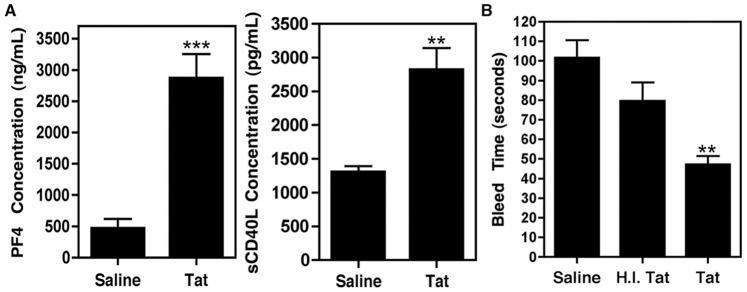
Figure 1
HIV Tat activates platelets in vivo.
( A ) Plasma concentrations of platelet factor 4 (PF4) and soluble CD40L (sCD40L) in wild-type C57BL/6 (WT) mice were measured via ELISA. Upon injection with HIV Tat (100 ng/g body weight; nu200a=u200...
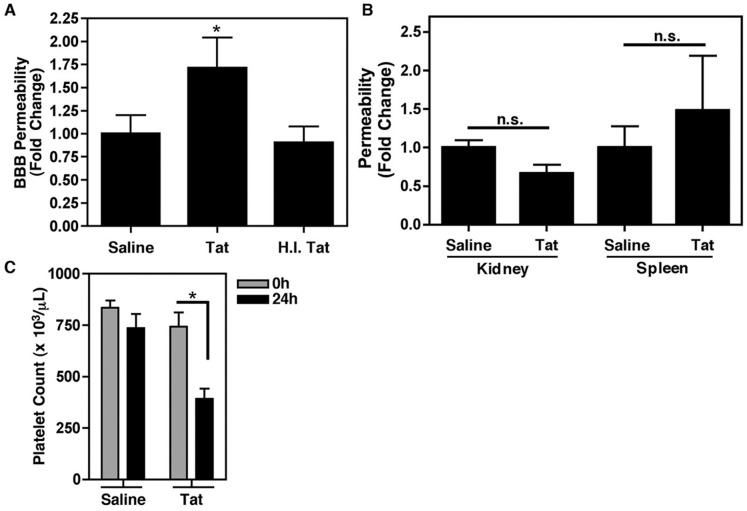
Figure 2
Tat increases blood brain barrier (BBB) permeability.
( A ) Wild-type C57BL/6 (WT) mice were treated with Tat (1 u00b5g/g body weight; nu200a=u200a6) for 24 h. The fluorescent tracer sodium fluorescein (NaF) was then used to assess BBB permeability. HIV ...
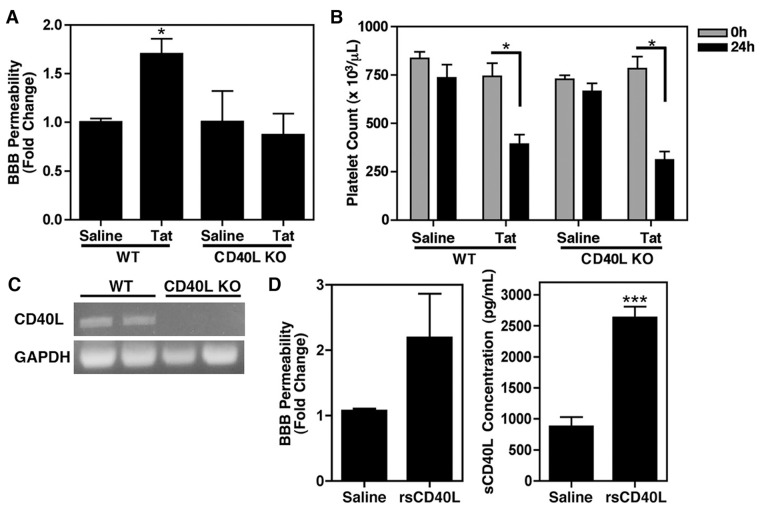
Figure 3
CD40L is required for Tat-induced BBB permeability.
( A ) Wild-type C57BL/6 (WT) or CD40L deficient (CD40L KO) mice were injected retro-orbitally with HIV Tat (1 u00b5g/g body weight; nu200a=u200a6 per group), while control mice were injected with sali...
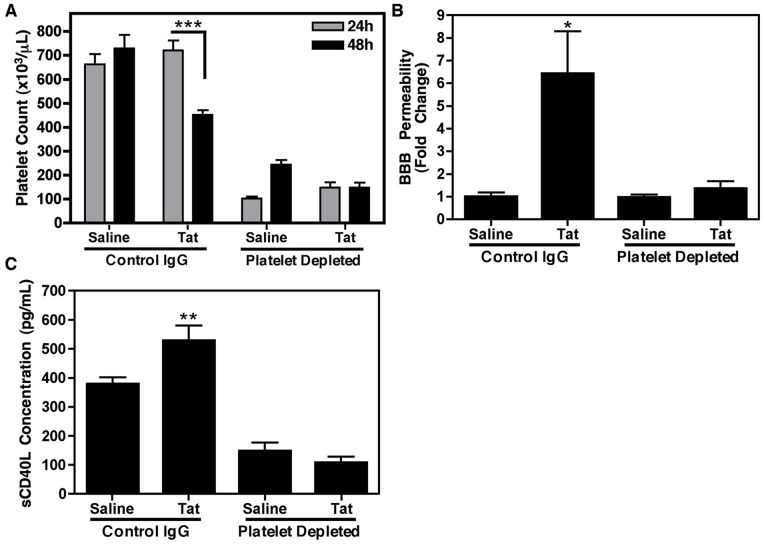
Figure 4
Platelet-derived sCD40L is contributing to Tat-induced BBB permeability.
( A ) Complete blood counts verified efficient platelet depletion in wild-type C57BL/6 (WT) animals (nu200a=u200a6) 24 h following treatment with antibodies for either platelet depletion or control, n...
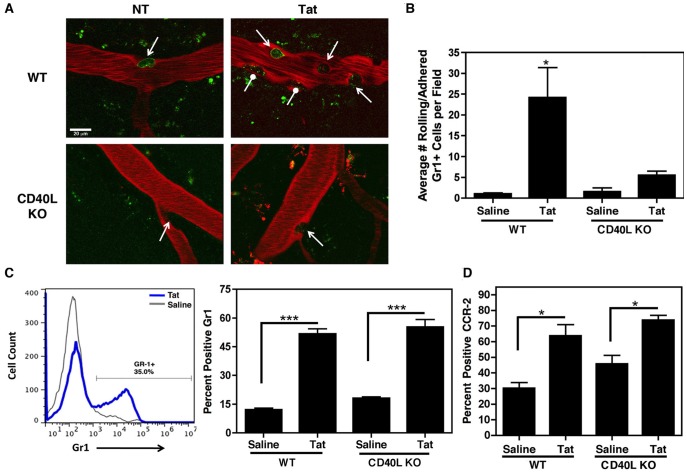
Figure 5
Tat increases the number of rolling and adhered leukocytes to the brain microvasculature.
( A ) Representative images of cortical two-photon time-lapse videos in wild-type C57BL/6 (WT) or CD40L deficient (CD40L KO) mice (nu200a=u200a3). Tat (1 u00b5g/g body weight) was injected retro-orbit...
Figure images are served from the NIH/NLM PubMed Central Open Access Subset or Europe PMC; copyright remains with the publishers and authors.
💬 Discussion
0 commentsNo comments yet. Be the first to start a discussion!
Leave a Comment