Abstract
Abstract Cells are a fundamental unit of biological organization, and identifying them in imaging data – cell segmentation – is a critical task for various cellular imaging experiments. While deep learning methods have led to substantial progress on this problem, most models are specialist models that work well for specific domains but cannot be applied across domains or scale well with large amounts of data. In this work, we present CellSAM, a universal model for cell segmentation that generalizes across diverse cellular imaging data. CellSAM builds on top of the Segment Anything Model (SAM) by developing a prompt engineering approach for mask generation. We train an object detector, CellFinder, to automatically detect cells and prompt SAM to generate segmentations. We show that this approach allows a single model to achieve human-level performance for segmenting images of mammalian cells, yeast, and bacteria collected across various imaging modalities. We show that CellSAM has strong zero-shot performance and can be improved with a few examples via few-shot learning. Additionally, we demonstrate how CellSAM can be applied across diverse bioimage analysis workflows. A deployed version of CellSAM is available at https://cellsam.deepcell.org/ .
🔬 Techniques
✨ Fluorophores
🧪 Sample Preparation
🔬 Cell Lines
🧪 Reagent Suppliers
📷 Detectors
💻 Software Details
🏛️ Research Organizations (ROR)
Affiliated research institutions:
📊 Figures
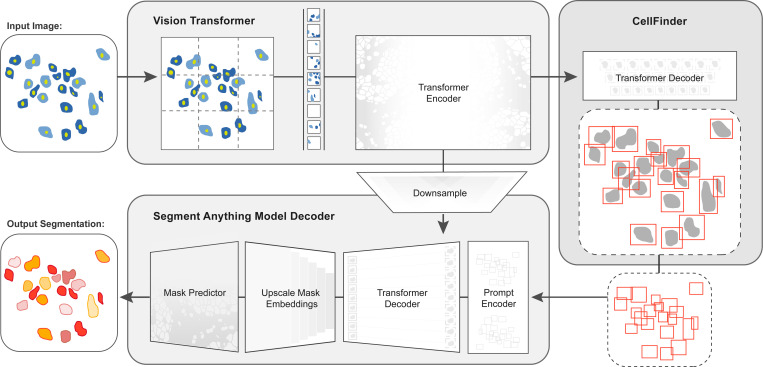
Fig. 1:
CellSAM: a foundational model for cell segmentation.
CellSAM combines SAMu2019s mask generation and labeling capabilities with an object detection model to achieve automated inference. Input images are divided into regularly sampled patches and passed t...
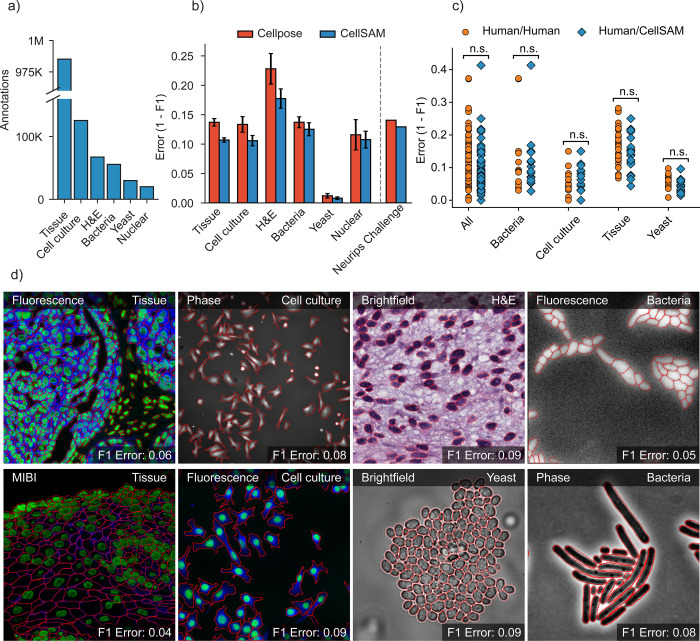
Fig. 2:
CellSAM is a strong generalist model for cell segmentation.
a) For training and evaluating CellSAM, we curated a diverse cell segmentation dataset from the literature. The number of annotated cells is given for each data type. Nuclear refers to a heterogeneous...
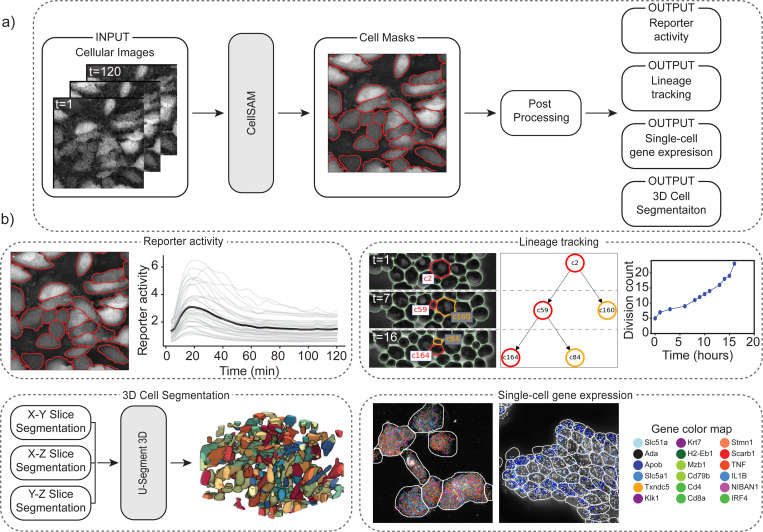
Fig. 3:
CellSAM unifies biological imaging analysis workflows.
Because CellSAM-generalist functions across image modalities and cellular targets, it can be immediately applied across bioimaging analysis workflows without requiring task-specific adaptations. (a) W...
Figure images are served from the NIH/NLM PubMed Central Open Access Subset or Europe PMC; copyright remains with the publishers and authors.
💬 Discussion
0 commentsNo comments yet. Be the first to start a discussion!
Leave a Comment