Abstract
The development of new techniques to study glial cells has revealed that they are active participants in the development of functional neuronal circuits. Calcium imaging studies demonstrate that glial cells actively sense and respond to neuronal activity. Glial cells can produce and release neurotransmitter-like molecules, referred to as gliotransmitters, that can in turn influence the activity of neurons and other glia. One putative gliotransmitter, D-serine is believed to be an endogenous co-agonist for synaptic N-methyl-D-aspartate receptors (NMDARs), modulating synaptic transmission and plasticity mediated by this receptor. The observation that D-serine levels in the mammalian brain increase during early development, suggests a possible role for this gliotransmitter in normal brain development and circuit refinement. In this review we will examine the data that D-serine and its associated enzyme serine racemase are developmentally regulated. We will consider the evidence that D-serine is actively released by glial cells and examine the studies that have implicated D-serine as a critical player involved in regulating NMDAR-mediated synaptic transmission and neuronal migration during development. Furthermore, we will consider how dysregulation of D-serine may play an important role in the etiology of neurological and psychiatric diseases.
🔬 Techniques
✨ Fluorophores
🧪 Sample Preparation
🔬 Cell Lines
🏛️ Research Organizations (ROR)
Affiliated research institutions:
📊 Figures
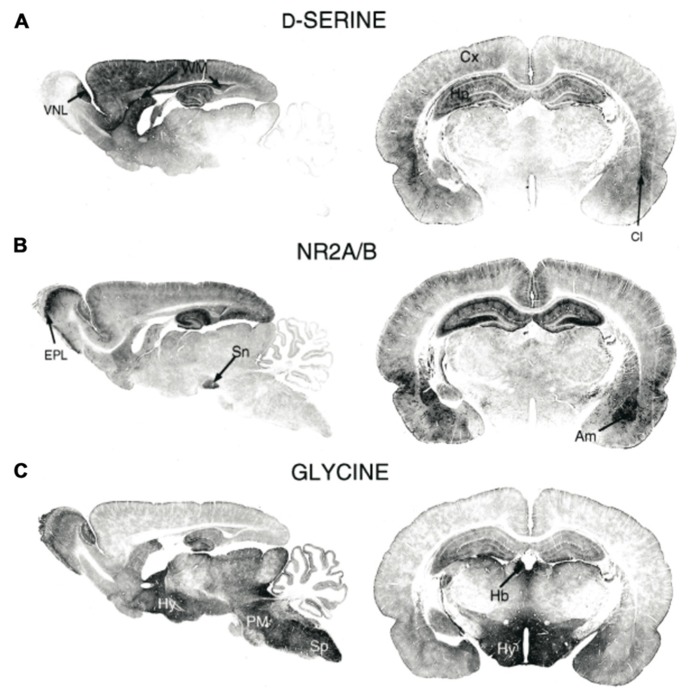
FIGURE 1
Immunohistochemical staining of (A) D-serine, (B) NMDAR subunits GluN2A/B, and (C) glycine in rat brains (P21). Am, amygdala; Cl, claustrum; Cx, cortex; EPL, external plexiform layer; Hb, habenula; Hy...
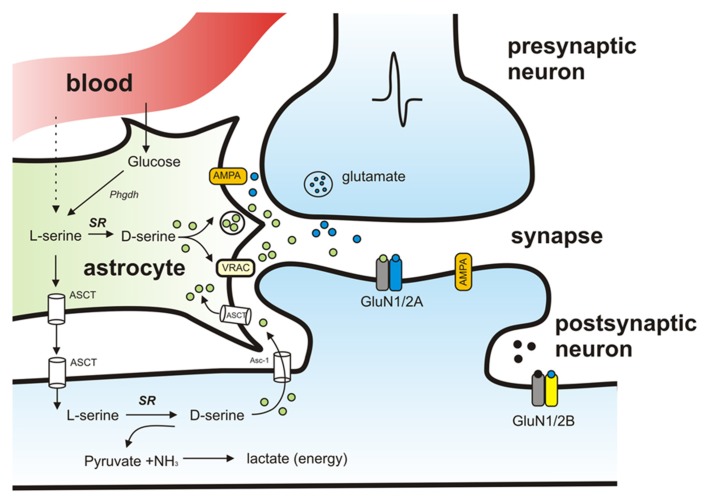
FIGURE 2
Schematic model of the proposed pathways mediating D-serine synthesis and release. Activation of presynaptic neuron results in release of glutamate that binds to AMPA receptors on neighboring astrocyt...
Figure images are served from the NIH/NLM PubMed Central Open Access Subset or Europe PMC; copyright remains with the publishers and authors.
💬 Discussion
0 commentsNo comments yet. Be the first to start a discussion!
Leave a Comment