Abstract
Most animals rely on olfaction to find sexual partners, food or a habitat. The olfactory system faces the challenge of extracting meaningful information from a noisy odorous environment. In most moth species, males respond to sex pheromone emitted by females in an environment with abundant plant volatiles. Plant odours could either facilitate the localization of females (females calling on host plants), mask the female pheromone or they could be neutral without any effect on the pheromone. Here we studied how mixtures of a behaviourally-attractive floral odour, heptanal, and the sex pheromone are encoded at different levels of the olfactory pathway in males of the noctuid moth Agrotis ipsilon. In addition, we asked how interactions between the two odorants change as a function of the males' mating status. We investigated mixture detection in both the pheromone-specific and in the general odorant pathway. We used a) recordings from individual sensilla to study responses of olfactory receptor neurons, b) in vivo calcium imaging with a bath-applied dye to characterize the global input response in the primary olfactory centre, the antennal lobe and c) intracellular recordings of antennal lobe output neurons, projection neurons, in virgin and newly-mated males. Our results show that heptanal reduces pheromone sensitivity at the peripheral and central olfactory level independently of the mating status. Contrarily, heptanal-responding olfactory receptor neurons are not influenced by pheromone in a mixture, although some post-mating modulation occurs at the input of the sexually isomorphic ordinary glomeruli, where general odours are processed within the antennal lobe. The results are discussed in the context of mate localization.
🔬 Techniques
💻 Software
✨ Fluorophores
🧪 Sample Preparation
🏭 Microscope Brands
🧪 Reagent Suppliers
📷 Detectors
💻 Software Details
🏛️ Research Organizations (ROR)
Affiliated research institutions:
📋 Methods
Insects Adult males and females of the noctuid moth, A. ipsilon Hufnagel, were reared in the laboratory, and behavioural and physiological experiments were performed as described previously [21] , [25] . Briefly, 5-day old sexually mature virgin and mated males were used for experiments during the 8-hour scotophase. Newly-mated males were obtained by pairing virgin 5-day-old males and 3-day-old sexually mature females before the onset of the scotophase. Newly–mated males were prepared for calcium imaging or electrophysiological recordings within one to two hours after the end of copulation, and females were dissected to confirm the presence of the male spermatophore.
Odour Stimulation
For electrophysiological experiments, odour stimulations with sex pheromone blend and heptanal were performed as described previously [21] , [40] . Briefly, the behaviourally active pheromone blend consisting of ( Z )7-dodecen-1-yl acetate, ( Z )9-tetradecen-1-yl acetate and ( Z ) 11-hexadecen-1-yl acetate at a ratio 4∶1∶4 [41] , and the behaviourally attractive plant odour, heptanal [27] , were used in all experiments. Ten ng of the pheromone blend diluted in hexane were used in ORN recordings and imaging experiments because they elicit a clear response [25] . For AL intracellular recordings 1 ng and 10 ng doses of the pheromone were used for virgin and mated males respectively, because of a higher sensitivity of central neurons in virgin males [21] . Four doses of heptanal (1, 10, 100 and 1000 µg each diluted in 10 µl of mineral oil, resulting in concentrations of 1/10.000 to 1/10 volume/volume) were used for electrophysiological recordings and imaging experiments. All compounds were purchased from Sigma Aldrich (Saint-Quentin Fallavier, France) and 10 µl of stimulus solution were applied on a piece of filter paper (0.5×2 cm, Fisherbrand, Fisher Bioblock, Illkirch, France) introduced in a Pasteur pipette. The solvents hexane and mineral oil applied on a filter paper were used as control stimuli. When stimulating with mixtures, two filter papers were inserted into a glass pipette; then the pheromone (diluted in hexane) and heptanal (diluted in mineral oil) were added separately on the filter papers. This procedure avoided interactions between the two odour solutions, but allowed simultaneous application of the two stimuli in the same air puff. To exclude potential absorption of the pheromone in mineral oil or changes in the airflow due to a second filter paper in the pipette, we carried out control experiments under exactly the same experimental conditions as in the main experiments, in which we stimulated Phe-ORNs with: 1- a single filter paper with pheromone (phe), 2- one filter paper with pheromone and a second clean filter paper (phe+cfp), 3- one filter paper with pheromone and a second filter paper with mineral oil (phe+oil), 4- a single filter paper with mineral oil (oil). Phe-ORN spike response frequencies did not change significantly when a second clean filter paper or a filter paper with mineral oil was inserted in the pipette with respect to the pheromone alone (Tukey test p>0.05), but as expected, responses were significantly lower when only mineral oil was used (Tukey test, oil vs. phe, phe+cfp, phe+oil, p
Show full methods section
Insects Adult males and females of the noctuid moth, A. ipsilon Hufnagel, were reared in the laboratory, and behavioural and physiological experiments were performed as described previously [21] , [25] . Briefly, 5-day old sexually mature virgin and mated males were used for experiments during the 8-hour scotophase. Newly-mated males were obtained by pairing virgin 5-day-old males and 3-day-old sexually mature females before the onset of the scotophase. Newly–mated males were prepared for calcium imaging or electrophysiological recordings within one to two hours after the end of copulation, and females were dissected to confirm the presence of the male spermatophore.
Odour Stimulation
For electrophysiological experiments, odour stimulations with sex pheromone blend and heptanal were performed as described previously [21] , [40] . Briefly, the behaviourally active pheromone blend consisting of ( Z )7-dodecen-1-yl acetate, ( Z )9-tetradecen-1-yl acetate and ( Z ) 11-hexadecen-1-yl acetate at a ratio 4∶1∶4 [41] , and the behaviourally attractive plant odour, heptanal [27] , were used in all experiments. Ten ng of the pheromone blend diluted in hexane were used in ORN recordings and imaging experiments because they elicit a clear response [25] . For AL intracellular recordings 1 ng and 10 ng doses of the pheromone were used for virgin and mated males respectively, because of a higher sensitivity of central neurons in virgin males [21] . Four doses of heptanal (1, 10, 100 and 1000 µg each diluted in 10 µl of mineral oil, resulting in concentrations of 1/10.000 to 1/10 volume/volume) were used for electrophysiological recordings and imaging experiments. All compounds were purchased from Sigma Aldrich (Saint-Quentin Fallavier, France) and 10 µl of stimulus solution were applied on a piece of filter paper (0.5×2 cm, Fisherbrand, Fisher Bioblock, Illkirch, France) introduced in a Pasteur pipette. The solvents hexane and mineral oil applied on a filter paper were used as control stimuli. When stimulating with mixtures, two filter papers were inserted into a glass pipette; then the pheromone (diluted in hexane) and heptanal (diluted in mineral oil) were added separately on the filter papers. This procedure avoided interactions between the two odour solutions, but allowed simultaneous application of the two stimuli in the same air puff. To exclude potential absorption of the pheromone in mineral oil or changes in the airflow due to a second filter paper in the pipette, we carried out control experiments under exactly the same experimental conditions as in the main experiments, in which we stimulated Phe-ORNs with: 1- a single filter paper with pheromone (phe), 2- one filter paper with pheromone and a second clean filter paper (phe+cfp), 3- one filter paper with pheromone and a second filter paper with mineral oil (phe+oil), 4- a single filter paper with mineral oil (oil). Phe-ORN spike response frequencies did not change significantly when a second clean filter paper or a filter paper with mineral oil was inserted in the pipette with respect to the pheromone alone (Tukey test p>0.05), but as expected, responses were significantly lower when only mineral oil was used (Tukey test, oil vs. phe, phe+cfp, phe+oil, p
📊 Figures
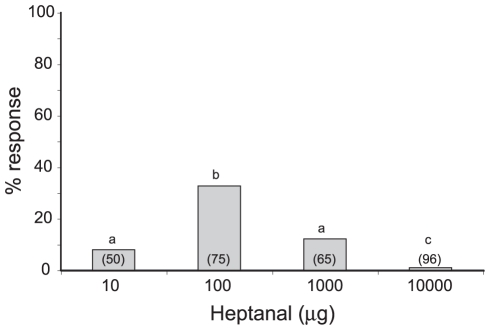
Figure 1
Behavioural responses of virgin A. ipsilon males to heptanal.
The proportion of males showing an oriented flight towards the stimulus source was highest at a dose of 100 u00b5g heptanal. Numbers in brackets represent the numbers of tested males. Bars with same l...
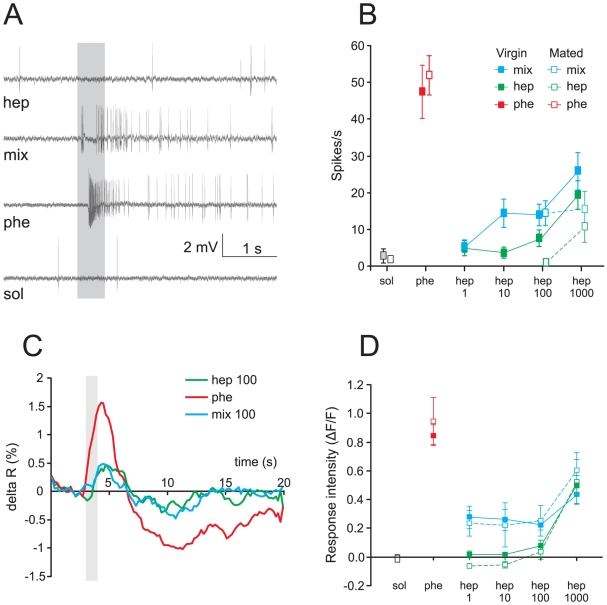
Figure 2
Pheromone-responding ORNs and MGC calcium responses in virgin and mated males.
A ) Typical single sensillum recordings showing an olfactory receptor neuron (ORN) excitatory response to the pheromone (10 ng), no response to heptanal (100 u00b5g) and a reduced response to the pher...
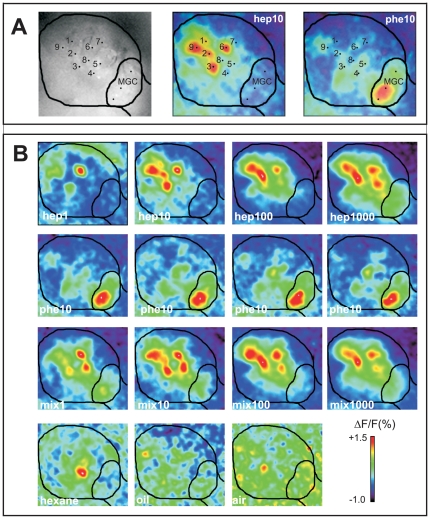
Figure 3
Odour-evoked calcium signals in the antennal lobe.
A ) Example of an anatomical staining of a right antennal lobe (AL) with the outline of the entire AL and MGC. Two activity maps obtained in response to heptanal (10 u00b5g) (hep10) and to the pheromo...
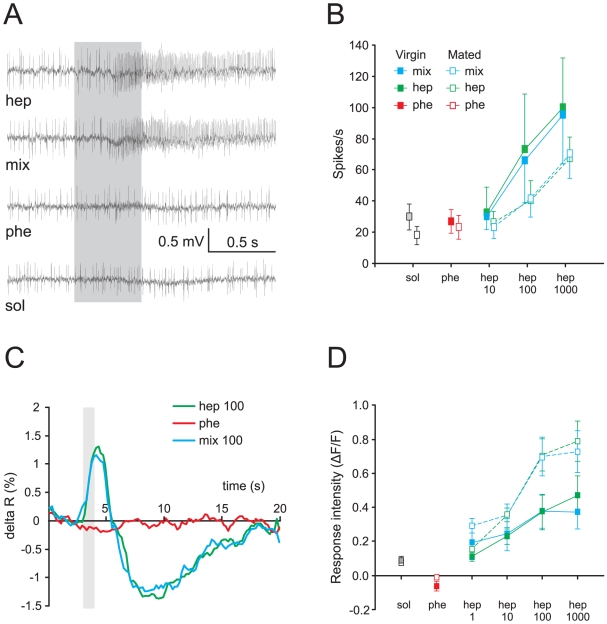
Figure 4
Heptanal-sensitive ORNs and OG calcium-evoked responses in virgin and mated males.
A ) Typical recording showing an excitatory response to heptanal (100 u00b5g), no response to the pheromone (10 ng) and the solvent (mineral oil), and excitation to the pheromone/heptanal mixture in a...
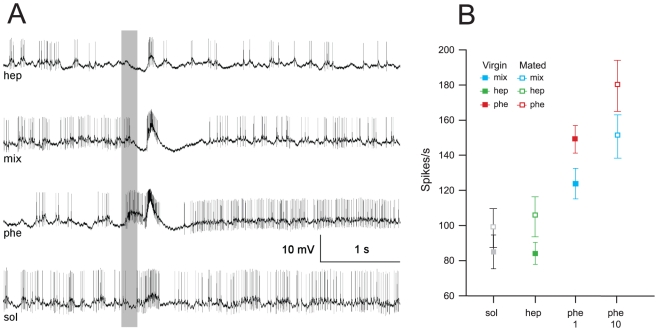
Figure 5
Responses of AL PNs within the MGC of virgin and mated males.
A ) Typical responses of a pheromone-sensitive PN in a virgin male, showing an excitatory response to pheromone (1 ng), no response to heptanal (100 u00b5g) and the solvent (hexane), and a reduced fir...
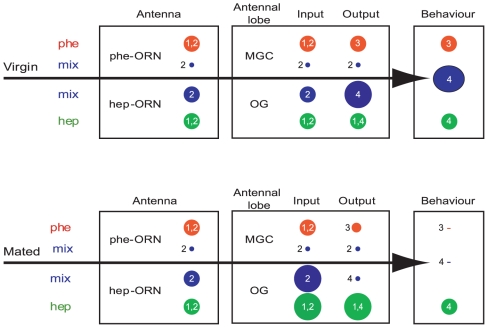
Figure 6
Sex pheromone-plant odour interactions in the olfactory pathway of virgin and mated A. ipsilon males.
Whereas pheromone sensitivity decreases drastically in AL output neurons after mating, heptanal sensitivity seems to increase already at the AL input level. Synergistic behavioural responses to odour ...
Figure images are served from the NIH/NLM PubMed Central Open Access Subset or Europe PMC; copyright remains with the publishers and authors.
💬 Discussion
0 commentsNo comments yet. Be the first to start a discussion!
Leave a Comment