Abstract
Antidepressants target the serotonin transporter (SERT) by inhibiting serotonin reuptake. Structural and biochemical studies aiming to understand binding of small-molecules to conformationally dynamic transporters like SERT often require thermostabilizing mutations and antibodies to stabilize a specific conformation, leading to questions about relationships of these structures to the bonafide conformation and inhibitor binding poses of wild-type transporter. To address these concerns, we determined the structures of ∆N72/∆C13 and ts2-inactive SERT bound to paroxetine analogues using single-particle cryo-EM and x-ray crystallography, respectively. We synthesized enantiopure analogues of paroxetine containing either bromine or iodine instead of fluorine. We exploited the anomalous scattering of bromine and iodine to define the pose of these inhibitors and investigated inhibitor binding to Asn177 mutants of ts2-active SERT. These studies provide mutually consistent insights into how paroxetine and its analogues bind to the central substrate-binding site of SERT, stabilize the outward-open conformation, and inhibit serotonin transport.
🔬 Techniques
🔭 Microscopes
🧬 Organisms
✨ Fluorophores
🧪 Sample Preparation
🏭 Microscope Brands
🧪 Reagent Suppliers
📷 Detectors
💻 Software Details
💾 Data Repositories
🏷️ Research Resource Identifiers (RRIDs)
Verified research resources used in this paper:
🏛️ Research Organizations (ROR)
Affiliated research institutions:
📋 Methods
Key resources table
Reagent type (species) or resource Designation Source or reference Identifiers Additional information Gene ( Homo sapiens ) Human serotonin transporter cDNA NCBI Reference Sequence: NP_001036.1 Dr. Randy D. Blakely (Florida Atlantic university brain institute) Cell line ( Homo sapiens ) HEK293S GnTI- ATCC Cat # ATCC CRL-3022 Used for expression of SERT (PMID: 27929454 ) Cell line ( Spodoptera frugiperda ) SF9 cells ATCC Cat # ATCC CRL-1711 Used in production of baculovirus for transduction, and SERT antibodies (PMID: 27929454 ) Antibody Mouse monoclonal. Isotype IgG2a, kappa OHSU VGTI, Monoclonal Antibody Core 8B6 Transfected construct (human) pEG BacMam Gouaux lab PMID: 25299155 Affinity chromatography resin Strep-Tactin Superflow high capacity resin Iba life sciences Cat#2-1208-500 Chemical compound, drug n-dodecyl-β-D-maltoside Anatrace Cat # D310 Detergent Chemical compound, drug n-octyl β-D-maltoside Anatrace Cat # O310 Detergent Chemical compound, drug fluorinated octyl-maltoside Anatrace Cat # O310F Detergent Chemical compound, drug Cholesteryl Hemisuccinate Anatrace Cat # CH210 Lipid Chemical compound, drug 1-palmitoyl-2-oleoyl-sn-glycero-3-phosphocholine Anatrace Cat # P516 Lipid Chemical compound, drug 1-palmitoyl-2-oleoyl-sn-glycero-3-phosphoethanolamine Anatrace Cat # P416 Lipid Chemical compound, drug 1-palmitoyl-2-oleoyl-sn-glycero-3-phosphoglycerol Anatrace Cat # P616 Lipid Chemical compound, drug Paroxetine hydrochloride hemihydrate Sigma Cat # P9623 Inhibitor Chemical compound, drug [ 3 H]5-HT PerkinElmer Cat # NET1167250UC Radiolabeled substrate Chemical compound, drug [ 3 H]citalopram PerkinElmer Cat # NET1039250UC Radiolabeled inhibitor Software, algorithm XDS PMID: 20124692 RRID: SCR_015652 http://xds.mpimf-heidelberg.mpg.de/ Software, algorithm Phaser PMID: 24189240 RRID: SCR_014219 https://www.phaser.cimr.cam.ac.uk/index.php/Phaser_Crystallographic_Software Software, algorithm Phenix PMID: 22505256 RRID: SCR_014224 https://www.phenix-online.org/ Software, algorithm SerialEM PMID: 16182563 RRID: SCR_017293 http://bio3d.colorado.edu/SerialEM Software, algorithm MotionCor2 PMID: 28250466 RRID: SCR_016499 http://msg.ucsf.edu/em/software/motioncor2.html Software, algorithm CTFFIND4 PMID: 26278980 RRID: SCR_016732 https://grigoriefflab.umassmed.edu/ctffind4 Software, algorithm DoG-Picker PMID: 19374019 http://emg.nysbc.org/redmine/projects/software/wiki/DoGpicker Software, algorithm cryoSPARC PMID: 28165473 RRID: SCR_016501 https://cryosparc.com/ Software, algorithm RELION PMID: 23000701 RRID: SCR_016274 http://www2.mrc-lmb.cam.ac.uk/relion Software, algorithm cisTEM PMID: 29513216 RRID: SCR_016502 https://cistem.org/ Software, algorithm UCSF-Chimera PMID: 15264254 RRID: SCR_004097 https://www.cgl.ucsf.edu/chimera/ Software, algorithm Coot PMID: 15572765 RRID: SCR_014222 https://www2.mrc-lmb.cam.ac.uk/personal/pemsley/coot Software, algorithm MolProbity PMID: 20057044 RRID: SCR_014226 http://molprobity.biochem.duke.edu/ Other R 2/2 200 mesh Au holey carbon grids Electron Microscopy Sciences Cat # Q2100AR2 Cryo-EM grids Other Copper HIS-Tag YSI PerkinElmer Cat # RPNQ0096 SPA beads SERT expression and purification The human SERT constructs used in this study were the wild-type, the N- and C-terminally truncated wild-type (ΔN72/ΔC13), ts2-inactive (Tyr110Ala, Ile291Ala), and ts2-active (Ile291Ala, Thr439Ser) ( Coleman and Gouaux, 2018 ; Coleman et al., 2016a ; Green et al., 2015 ; Coleman et al., 2019 ; Coleman et al., 2016b ) proteins ( Table 1 ). The Asn177 mutants were generated in the ts2-active background. The expression and purification of SERT was carried out as previously described with minor modifications ( Coleman and Gouaux, 2018 ; Coleman et al., 2016a ; Coleman et al., 2019 ; Coleman et al., 2016b ), as described below. All SERT constructs were cloned into BacMam vector system to be expressed as C-terminal GFP fusion using baculovirus-mediated transduction of HEK293S GnTI - cells. Cells were solubilized in 20 mM Tris pH 8 with 150 mM NaCl, containing 20 mM n-dodecyl-β-D-maltoside (DDM) and 2.5 mM cholesteryl hemisuccinate (CHS), followed by purification using Strep-Tactin affinity chromatography in 20 mM Tris pH 8 with 100 mM NaCl (TBS), 1 mM DDM, and 0.2 mM CHS. For cryo-EM of the ΔN72/ΔC13 SERT, 1 mM 5-HT was added during solubilization and affinity purification to stabilize SERT. GFP was cleaved from SERT by digestion with thrombin and the SERT-8B6 complex was made as described in the previous paragraph. The complex was separated from free Fab and GFP by SEC in TBS containing 1 mM DDM and 0.2 mM CHS, and the peak fractions were concentrated to 4 mg/ml followed by addition of either 200 μM paroxetine, Br-paroxetine or I-paroxetine. For crystallization, no ligands were added during purification of ts2-inactive SERT, and 5% glycerol and 25 μM lipid (1-palmitoyl-2-oleoyl-sn-glycero-3-phosphocholine, 1-palmitoyl-2-oleoyl-sn-glycero-3-phosphoethanolamine, and 1-palmitoyl-2-oleoyl-sn-glycero-3-phosphoglycerol at a molar ratio of 1:1:1) were included in all the purification buffers. Following affinity purification, the fusion protein was digested by thrombin and EndoH and combined with recombinant 8B6 Fab at a molar ratio of 1:1.2. The SERT-8B6 complex was isolated by size-exclusion chromatography (SEC) on a Superdex 200 column in TBS containing 40 mM n-octyl β-D-maltoside, 0.5 mM CHS. The SERT-8B6 Fab complex was concentrated to 2 mg/ml and 1 μM 8B6 Fab and 50 μM Br-paroxetine or I-paroxetine was added prior to crystallization.
Show full methods section
Key resources table
Reagent type (species) or resource Designation Source or reference Identifiers Additional information Gene ( Homo sapiens ) Human serotonin transporter cDNA NCBI Reference Sequence: NP_001036.1 Dr. Randy D. Blakely (Florida Atlantic university brain institute) Cell line ( Homo sapiens ) HEK293S GnTI- ATCC Cat # ATCC CRL-3022 Used for expression of SERT (PMID: 27929454 ) Cell line ( Spodoptera frugiperda ) SF9 cells ATCC Cat # ATCC CRL-1711 Used in production of baculovirus for transduction, and SERT antibodies (PMID: 27929454 ) Antibody Mouse monoclonal. Isotype IgG2a, kappa OHSU VGTI, Monoclonal Antibody Core 8B6 Transfected construct (human) pEG BacMam Gouaux lab PMID: 25299155 Affinity chromatography resin Strep-Tactin Superflow high capacity resin Iba life sciences Cat#2-1208-500 Chemical compound, drug n-dodecyl-β-D-maltoside Anatrace Cat # D310 Detergent Chemical compound, drug n-octyl β-D-maltoside Anatrace Cat # O310 Detergent Chemical compound, drug fluorinated octyl-maltoside Anatrace Cat # O310F Detergent Chemical compound, drug Cholesteryl Hemisuccinate Anatrace Cat # CH210 Lipid Chemical compound, drug 1-palmitoyl-2-oleoyl-sn-glycero-3-phosphocholine Anatrace Cat # P516 Lipid Chemical compound, drug 1-palmitoyl-2-oleoyl-sn-glycero-3-phosphoethanolamine Anatrace Cat # P416 Lipid Chemical compound, drug 1-palmitoyl-2-oleoyl-sn-glycero-3-phosphoglycerol Anatrace Cat # P616 Lipid Chemical compound, drug Paroxetine hydrochloride hemihydrate Sigma Cat # P9623 Inhibitor Chemical compound, drug [ 3 H]5-HT PerkinElmer Cat # NET1167250UC Radiolabeled substrate Chemical compound, drug [ 3 H]citalopram PerkinElmer Cat # NET1039250UC Radiolabeled inhibitor Software, algorithm XDS PMID: 20124692 RRID: SCR_015652 http://xds.mpimf-heidelberg.mpg.de/ Software, algorithm Phaser PMID: 24189240 RRID: SCR_014219 https://www.phaser.cimr.cam.ac.uk/index.php/Phaser_Crystallographic_Software Software, algorithm Phenix PMID: 22505256 RRID: SCR_014224 https://www.phenix-online.org/ Software, algorithm SerialEM PMID: 16182563 RRID: SCR_017293 http://bio3d.colorado.edu/SerialEM Software, algorithm MotionCor2 PMID: 28250466 RRID: SCR_016499 http://msg.ucsf.edu/em/software/motioncor2.html Software, algorithm CTFFIND4 PMID: 26278980 RRID: SCR_016732 https://grigoriefflab.umassmed.edu/ctffind4 Software, algorithm DoG-Picker PMID: 19374019 http://emg.nysbc.org/redmine/projects/software/wiki/DoGpicker Software, algorithm cryoSPARC PMID: 28165473 RRID: SCR_016501 https://cryosparc.com/ Software, algorithm RELION PMID: 23000701 RRID: SCR_016274 http://www2.mrc-lmb.cam.ac.uk/relion Software, algorithm cisTEM PMID: 29513216 RRID: SCR_016502 https://cistem.org/ Software, algorithm UCSF-Chimera PMID: 15264254 RRID: SCR_004097 https://www.cgl.ucsf.edu/chimera/ Software, algorithm Coot PMID: 15572765 RRID: SCR_014222 https://www2.mrc-lmb.cam.ac.uk/personal/pemsley/coot Software, algorithm MolProbity PMID: 20057044 RRID: SCR_014226 http://molprobity.biochem.duke.edu/ Other R 2/2 200 mesh Au holey carbon grids Electron Microscopy Sciences Cat # Q2100AR2 Cryo-EM grids Other Copper HIS-Tag YSI PerkinElmer Cat # RPNQ0096 SPA beads SERT expression and purification The human SERT constructs used in this study were the wild-type, the N- and C-terminally truncated wild-type (ΔN72/ΔC13), ts2-inactive (Tyr110Ala, Ile291Ala), and ts2-active (Ile291Ala, Thr439Ser) ( Coleman and Gouaux, 2018 ; Coleman et al., 2016a ; Green et al., 2015 ; Coleman et al., 2019 ; Coleman et al., 2016b ) proteins ( Table 1 ). The Asn177 mutants were generated in the ts2-active background. The expression and purification of SERT was carried out as previously described with minor modifications ( Coleman and Gouaux, 2018 ; Coleman et al., 2016a ; Coleman et al., 2019 ; Coleman et al., 2016b ), as described below. All SERT constructs were cloned into BacMam vector system to be expressed as C-terminal GFP fusion using baculovirus-mediated transduction of HEK293S GnTI - cells. Cells were solubilized in 20 mM Tris pH 8 with 150 mM NaCl, containing 20 mM n-dodecyl-β-D-maltoside (DDM) and 2.5 mM cholesteryl hemisuccinate (CHS), followed by purification using Strep-Tactin affinity chromatography in 20 mM Tris pH 8 with 100 mM NaCl (TBS), 1 mM DDM, and 0.2 mM CHS. For cryo-EM of the ΔN72/ΔC13 SERT, 1 mM 5-HT was added during solubilization and affinity purification to stabilize SERT. GFP was cleaved from SERT by digestion with thrombin and the SERT-8B6 complex was made as described in the previous paragraph. The complex was separated from free Fab and GFP by SEC in TBS containing 1 mM DDM and 0.2 mM CHS, and the peak fractions were concentrated to 4 mg/ml followed by addition of either 200 μM paroxetine, Br-paroxetine or I-paroxetine. For crystallization, no ligands were added during purification of ts2-inactive SERT, and 5% glycerol and 25 μM lipid (1-palmitoyl-2-oleoyl-sn-glycero-3-phosphocholine, 1-palmitoyl-2-oleoyl-sn-glycero-3-phosphoethanolamine, and 1-palmitoyl-2-oleoyl-sn-glycero-3-phosphoglycerol at a molar ratio of 1:1:1) were included in all the purification buffers. Following affinity purification, the fusion protein was digested by thrombin and EndoH and combined with recombinant 8B6 Fab at a molar ratio of 1:1.2. The SERT-8B6 complex was isolated by size-exclusion chromatography (SEC) on a Superdex 200 column in TBS containing 40 mM n-octyl β-D-maltoside, 0.5 mM CHS. The SERT-8B6 Fab complex was concentrated to 2 mg/ml and 1 μM 8B6 Fab and 50 μM Br-paroxetine or I-paroxetine was added prior to crystallization.
Synthesis of Br- and I-paroxetine
All reactions were carried out under an inert atmosphere (argon) with flame-dried glassware using standard techniques, unless otherwise specified. Anhydrous solvents were obtained by filtration through drying columns (THF, MeCN, CH 2 Cl 2 and DMF) or used as supplied (α,α,α-trifluorotoluene). Reactions in sealed tubes were run using Biotage microwave vials (2–5 ml or 10–20 ml recommended volumes). Aluminum caps equipped with molded butyl/PTFE septa were used for reactions in α,α,α-trifluorotoluene and toluene. Simple butyl septa were used for reactions in other solvents. Chromatographic purification was performed using 230–400 mesh silica with the indicated solvent system according to standard techniques.
Analytical thin-layer chromatography
(TLC) was performed on precoated, glass-backed silica gel plates. Visualization of the developed chromatogram was performed by UV absorbance (254 nm) and/or stained with a ninhydrin solution in ethanol. HPLC analyses were carried out on an Agilent 1260 Infinity Series system, employing Daicel Chiracel columns, under the indicated conditions. The high-resolution mass spectrometry (HRMS) analyses were performed using electrospray ion source (ESI). ESI was performed using a Waters LCT Premier equipped with an ESI source operated either in positive or negative ion mode. The software used was MassLynx 4.1; this software does not account for the electron and all the calibrations/references are calculated accordingly, that is [M+H] + is detected and the mass is calibrated to output [M+H]. Melting points are uncorrected. Infrared spectra (FTIR) were recorded in reciprocal centimeters (cm –1 ). Nuclear magnetic resonance spectra were recorded on 400 or 500 MHz spectrometers. The frequency used to record the NMR spectra is given in each assignment and spectrum ( 1 H NMR at 400 or 500 MHz; 13 C NMR at 101 MHz or 126 MHz). Chemical shifts for 1 H NMR spectra were recorded in parts per million from tetramethylsilane with the residual protonated solvent resonance as the internal standard (CHCl 3 : δ 7.27 ppm, (CD 2 H) 2 SO: δ 2.50 ppm, CD 2 HOD: δ 3.31 ppm). Data was reported as follows: chemical shift (multiplicity [s = singlet, d = doublet, t = triplet, m = multiplet and br = broad], coupling constant, integration and assignment). J values are reported in Hz. All multiplet signals were quoted over a chemical shift range. 13 C NMR spectra were recorded with complete proton decoupling. Chemical shifts were reported in parts per million from tetramethylsilane with the solvent resonance as the internal standard ( 13 CDCl 3 : δ 77.0 ppm, ( 13 CD 3 ) 2 SO: δ 39.5 ppm, 13 CD 3 OD: δ 49.0 ppm). Assignments of 1 H and 13 C spectra, as well as cis- or trans -configuration, were based upon the analysis of δ and J values, analogy with previously reported compounds ( Antermite et al., 2018 ), as well as DEPT, COSY and HSQC experiments, where appropriate. All Boc containing compounds appeared as a mixture of rotamers in the NMR spectra at room temperature. In some cases, NMR experiments for these compounds were carried out at 373 K to coalesce the signals, which is indicated in parentheses where appropriate. For NMR analysis performed at room temperature, 2D NMR experiments (COSY and HSQC) are also presented when useful for the assignments. Observed optical rotation (α’) was measured at the indicated temperature (T °C) and values were converted to the corresponding specific rotations α D T in deg cm 2 g –1 , concentration ( c ) in g per 100 mL. Full details of the synthetic route, using enantiopure and racemic substrates are provided in Appendix 1, and NMR spectra of all reaction intermediates, 2 and 3, and HPLC analysis are cataloged in Supplementary files 1 and 2 . Crystallization Crystals of ts2-inactive SERT-8B6 Fab complex were grown by hanging-drop vapor diffusion at 4°C at a ratio of 2:1 (v/v) protein:reservoir. Br-paroxetine crystals were grown using reservoir solution containing 50 mM Tris pH 8.5, 20 mM Na 2 (SO4), 20 mM LiCl 2 , 36% PEG 400, and 0.5% 6-aminohexanoic acid. I-paroxetine crystals were grown using a reservoir solution containing 100 mM HEPES pH 7.5, 40 mM MgCl 2 , and 32% PEG 400.
X-ray data collection
Crystals were harvested and flash cooled in liquid nitrogen. Data was collected at the Advanced Photon Source (Argonne National Laboratory, beamline 24-ID-C). Data for Br-paroxetine was collected at a wavelength of 0.91840 Å and at 1.37760 Å for I-paroxetine. Anomalous difference maps X-ray data sets were processed with XDS ( Kabsch, 2010 ); Friedel pairs were allowed to have different intensities. Molecular replacement was performed with coordinates from the previously determined ts2-inactive SERT-paroxetine structure (Protein Data Bank (PDB) code: 6AWN) ( Coleman and Gouaux, 2018 ) using PHASER ( Bunkóczi et al., 2013 ). B-factors were refined using PHENIX ( Afonine et al., 2012 ) followed by generating anomalous difference maps using the phases derived from the higher resolution structures. To maximize the signal-to-noise ratio of the Br-paroxetine anomalous difference density, the high-resolution phases were blurred with a B-factor of 500 with a high-resolution cutoff of 5.5 Å. Using these optimized parameters for the Fourier analysis of the Br-paroxetine diffraction data, we obtained an anomalous map with the largest difference peak being present at 6.0σ and the noise level estimated at ~ 2.5σ. To maximize the signal-noise-ratio of the I-paroxetine anomalous difference density, a high-resolution and low-resolution cutoff of 6.3 and 30 Å was applied during the generation of the anomalous maps. Using these optimized parameters for the Fourier analysis of the I-paroxetine diffraction data, we obtained an anomalous map with the largest difference peak being present at 4.5σ and the noise level estimated at ~ 2.5σ. F o -F o isomorphous difference maps Isomorphous difference (F o -F o ) maps were calculated in PHENIX by analyzing isomorphous pairs of crystals. Difference maps were calculated using the previously determined ts2-inactive SERT-paroxetine dataset and PDB (6AWN) for phasing. High- and low-resolution cutoffs of 6.0 and 30.0 Å were applied for the F o (paroxetine)- F o (Br-paroxetine) map and cutoffs of 6.3 and 30.0 Å were used for the F o (paroxetine)- F o (I-paroxetine) and F o (Br-paroxetine)- F o (I-paroxetine) maps.
Cryo-EM grid preparation
To promote the inclusion of particles in thin ice, 100 μM fluorinated octyl-maltoside (final concentration) from a 10 mM stock was added to SERT-8B6 complexes immediately prior to vitrification. Quantifoil holey carbon gold grids, 2.0/2.0 μm, size/hole space, 200 mesh) were glow discharged for 60 s at 15 mA. SERT-8B6 Fab complex (2.5 μl) was applied to the grid followed by blotting for 2 s in the vitrobot and plunging into liquid ethane cooled by liquid N 2 .
Cryo-EM data collection and processing
Images were acquired using the automated program SerialEM ( Mastronarde, 2005 ) on a FEI Titan Krios transmission electron microscope, operating at 300 keV and equipped with a Gatan Image Filter with the slit width set to 20 eV. A Gatan K3 direct electron detector was used to record movies in super-resolution counting mode with a binned pixel size of 0.648 Å per pixel. The defocus values ranged from −0.8 to −2.2 μm. Exposures of 1.0–1.5 s were dose fractioned into 40 frames, resulting in a total dose of 54–60 e − Å −2 . Movies were corrected for beam-induced motion using MotionCor2 ( Zheng et al., 2017 ) with 5 × 5 patching. The contrast transfer function (CTF) parameters for each micrograph was determined using ctffind4 ( Rohou and Grigorieff, 2015 ) and particles were picked either using DoG-Picker ( Voss et al., 2009 ) or blob-based picking in cryoSPARC ( Punjani et al., 2017 ). DoG or cryoSPARC picked particles were independently subjected to 3D classification against a low-resolution volume of the SERT-8B6 complex. After sorting, the DoG and cryoSPARC picked particles were combined in RELION ( Scheres, 2012 ) and the duplicate picks were removed (particle picks that are less than 100 Å of one another were considered duplicates). Combined particles were further sorted using reference-free 2D classification in cryoSPARC, followed by refinement in RELION and further 3D classification. Particles were then re-extracted (box size 400, 0.648 Å per pixel) and subjected to non-uniform refinement in cryoSPARC. Local refinement was then performed in cis TEM ( Grant et al., 2018 ) with a mask that excludes the micelle and Fab constant domain to remove low-resolution features. The high-resolution refinement limit was incrementally increased while maintaining a correlation of 0.95 or better until no improvement in map quality was observed. The resolution of the reconstructions was accessed using the Fourier shell correlation (FSC) criterion and a threshold of 0.143 ( Rosenthal and Henderson, 2003 ). Map sharpening was performed using local sharpening in PHENIX.
Cryo-EM model building and refinement
A starting model was generated by fitting the X-ray structure of SERT-8B6 Fab paroxetine complex (PDB code: 6AWN) into the cryo-EM reconstruction in Chimera ( Pettersen et al., 2004 ). Several rounds of manual adjustment and rebuilding were performed in Coot ( Emsley and Cowtan, 2004 ), followed by real space refinement in PHENIX. For cross-validation, the FSC curve between the refined model and half maps was calculated and compared to prevent overfitting. Molprobity was used to evaluate the stereochemistry and geometry of the structures ( Chen et al., 2010 ).
Radioligand binding and uptake assays
Competition binding experiments were performed using scintillation proximity assays (SPA) ( Green et al., 2015 ; Coleman et al., 2016b ). The assays contained ~ 10 nM SERT, 0.5 mg/ml Cu-Ysi beads in TBS with 1 mM DDM, 0.2 mM CHS, and 10 nM [ 3 H]citalopram and 0.01 nM–1 mM of the cold competitors. Experiments were measured in triplicate. The error bars for each data point represent the s.e.m. Ki values were determined with the Cheng–Prusoff equation ( Cheng and Prusoff, 1973 ) in GraphPad Prism. Uptake was measured as described previously in 96-well plates with [ 3 H]5-HT diluted 1:100 with unlabeled 5-HT. After 24 hr, cells were washed into uptake buffer (25 mM HEPES-Tris, pH 7.0, 130 mM NaCl, 5.4 mM KCl, 1.2 mM CaCl 2 , 1.2 mM MgSO 4 , 1 mM ascorbic acid and 5 mM glucose) containing 0.001–10,000 nM of the inhibitor. [ 3 H]5-HT was added to the cells and uptake was stopped by washing cells rapidly three times with uptake buffer. Cells were solubilized with 1% Triton-X100, followed by the addition of 200 μl of scintillation fluid to each well. The amount of labelled 5-HT was measured using a MicroBeta scintillation counter. Data were fit to a sigmoidal dose-response curve.
Additional files Supplementary file 1. HPLC Traces for Racemic, Scalemic and Enantioenriched Br-Piperidine Derivatives (±)-S2a, (±)-S3a, (+)-6a, (+)-7a, (–)-S3a, (–)-8a and (+)-S4a. Supplementary file 2. NMR Spectra for Novel Compounds. Transparent reporting form
Experimental details and characterization data
Synthesis of Br-analogue of (–)-paroxetine (compounds (±)-S2a, (±)-S3a, (+)−6a, (+)−7a, (–)-S3a, (–)−8a, (+)-S4a, (–)−9a and 2 ∙ HCl). Appendix 1—chemical structure 2. tert- Butyl cis- (±)−4-(4-bromophenyl)−3-(quinolin-8-ylcarbamoyl)piperidine-1-carboxylate ((±)-S2a) and tert- butyl trans- (±)−4 - (4 - bromophenyl)−3 - (quinolin - 8 - ylcarbamoyl)piperidine - 1 - carboxylate ((±)-S3a). A reaction tube was charged with K 2 CO 3 (69.1 mg, 0.50 mmol, one equiv), flame-dried, and allowed to cool under argon. tert -Butyl (±)−3-(quinoline-8-ylcarbamoyl)piperidine-1-carboxylate ((±)-S1) (178 mg, 0.50 mmol, one equiv), 4-bromoiodobenzene (424 mg, 1.50 mmol, three equiv), Pd(OAc) 2 (5.60 mg, 25.0 μmol, 5 mol %) and PivOH (51.2 mg, 0.50 mmol, one equiv) were added sequentially. The reaction vessel was sealed with an aluminum cap (with molded butyl/PTFE septa) and purged with argon, then anhydrous PhCF 3 (500 μL, 1.0 M) was added by syringe. The reaction tube was then placed in a preheated oil bath and stirred at 110°C for 18 hr. The reaction mixture was allowed to cool to rt and EtOAc (10 mL) was added. The resulting mixture was filtered through a pad of Celite, eluting with further EtOAc (2 × 10 mL). The solvent was removed under reduced pressure, and the crude material was purified by flash column chromatography (0% to 5% CH 3 CN/CH 2 Cl 2 ). The product containing fractions were combined and the solvent was removed under reduced pressure. Et 2 O (5 mL) and pentane (5 mL) were added and the solvent was removed under reduced pressure to afford the minor product tert– butyl trans- (±)−4 - (4 - bromophenyl)−3 - (quinolin - 8 - ylcarbamoyl) piperidine - 1 - carboxylate (±)-S3a as a pale yellow solid (34.5 mg, 14%) followed by the major product tert- butyl cis- (±)−4 - (4 - bromophenyl)−3 - (quinolin - 8 - ylcarbamoyl)piperidine - 1 - carboxylate (±)-S2a as an off-white solid (87.2 mg, 34%). Major ((±)-S2a) R f 0.31 (5% CH 3 CN/CH 2 Cl 2 ); mp = 81–86°C (from Et 2 O/pentane); ν max (film)/cm –1 3343 (NH), 2859, 1684 (C = O), 1521, 1484, 1423, 1364, 1323, 1245, 1163, 1006, 827, 790, 757; 1 H NMR (500 MHz, (CD 3 ) 2 SO, 373 K) δ 9.75 (br s, 1 hr, NH), 8.83 (dd, J = 4.2, 1.7 Hz, 1 hr, HC Ar ), 8.45 (dd, J = 7.7, 1.4 Hz, 1 hr, HC Ar ), 8.31 (dd, J = 8.3, 1.7 Hz, 1 hr, HC Ar ), 7.60–7.53 (m, 2 hr, HC Ar ), 7.48 (t, J = 7.9 Hz, 1 hr, HC Ar ), 7.40–7.34 (m, 2 hr, HC Ar ), 7.33–7.26 (m, 2 hr, HC Ar ), 4.42 (ddd, J = 14.8, 3.6, 1.7 Hz, 1 hr, NC H HCHCO), 4.25 (ddt, J = 13.1, 4.6, 2.3 Hz, 1 hr, NC H HCH 2 ), 3.36–3.28 (m, 2 hr, NCH H CHCO, CHCO), 3.16 (dt, J = 12.2, 4.0 Hz, 1 hr, CHAr), 3.02–2.92 (m, 1 hr, NCH H CH 2 ), 2.68 (qd, J = 12.4, 4.7 Hz, 1 hr, NCH 2 C H H), 1.72 (dq, J = 12.9, 3.2 Hz, 1 hr, NCH 2 CH H ), 1.25 (s, 9 hr, C(CH 3 ) 3 ); 13 C NMR (126 MHz, (CD 3 ) 2 SO, 373 K) δ 169.8 (C = O amide), 153.4 (C = O carbamate), 147.9 (C Ar ), 142.0 (C Ar quat), 137.6 (C Ar quat), 135.7 (C Ar ), 133.9 (C Ar quat), 130.3 (2 × C Ar ), 129.1 (2 × C Ar ), 127.2 (C Ar quat), 126.1 (C Ar ), 121.2 (C Ar ), 120.8 (C Ar ), 118.7 (BrC Ar quat), 115.7 (C Ar ), 77.9 ( C (CH 3 ) 3 ), 46.2 (N C H 2 CHCO), 45.6 ( C HCO), 42.9 (N C H 2 CH 2 ), 41.7 ( C HAr), 27.4 (C( C H 3 ) 3 ), 25.0 (NCH 2 C H 2 ); HRMS (ESI + ) m/z Calculated for C 26 H 29 N 3 O 3 79 Br [M+H] 510.1392; Found 510.1386. SMILES: O = C([C@H]1CN(C(OC(C)(C)C)=O)CC[C@H]1C2 = CC = C(Br)C = C2)NC3 = C(N = CC = C4)C4 = CC = C3 InChI = 1S/C26H28BrN3O3/c1-26(2,3)33-25(32)30-15-13-20(17-9-11-19(27)12-10-17)21(16-30)24(31)29-22-8-4-6-18-7-5-14-28-23(18)22/h4-12,14,20–21H,13,15–16 H2,1–3 H3,(H,29,31)/t20-,21-/m0/s1 Minor ((±)-S3a) R f 0.41 (5% CH 3 CN/CH 2 Cl 2 ); mp = 77–83°C (from Et 2 O/pentane); ν max (film)/cm –1 3340 (NH), 2926, 1677 (C = O), 1521, 1484, 1424, 1323, 1230, 1156, 1126, 999, 824, 757; 1 H NMR (500 MHz, (CD 3 ) 2 SO, 373 K) δ 9.73 (br s, 1 hr, NH), 8.85 (dd, J = 4.2, 1.7 Hz, 1 hr, HC Ar ), 8.39 (dd, J = 7.7, 1.4 Hz, 1 hr, HC Ar ), 8.31 (dd, J = 8.3, 1.7 Hz, 1 hr, HC Ar ), 7.61–7.54 (m, 2 hr, HC Ar ), 7.47 (t, J = 8.0 Hz, 1 hr, HC Ar ), 7.39–7.32 (m, 2 hr, HC Ar ), 7.34–7.28 (m, 2 hr, HC Ar ), 4.36 (ddd, J = 12.9, 3.7, 1.8 Hz, 1 hr, NC H HCHCO), 4.13 (ddt, J = 13.3, 4.3, 2.2 Hz, 1 hr, NC H HCH 2 ), 3.18–3.00 (m, 3 hr, NCH H CHCO, CHCO, CHAr), 2.99–2.90 (m, 1 hr, NCH H CH 2 ), 1.81 (dq, J = 12.9, 2.8 Hz, 1 hr, NCH 2 C H H), 1.66 (qd, J = 12.8, 4.6 Hz, 1 hr, NCH 2 CH H ), 1.49 (s, 9 hr, C(CH 3 ) 3 ); 13 C NMR (126 MHz, (CD 3 ) 2 SO, 373 K) δ 169.8 (C = O amide), 153.4 (C = O carbamate), 148.0 (C Ar ), 142.4 (C Ar quat), 137.7 (C Ar quat), 135.7 (C Ar ), 133.5 (C Ar quat), 130.6 (2 × C Ar ), 129.1 (2 × C Ar ), 127.2 (C Ar quat), 126.1 (C Ar ), 121.4 (C Ar ), 121.3 (C Ar ), 118.9 (BrC Ar quat), 116.3 (C Ar ), 78.6 ( C (CH 3 ) 3 ), 49.2 ( C HCO), 46.2 (N C H 2 CHCO), 43.9 ( C HAr), 43.3 (N C H 2 CH 2 ), 32.0 (NCH 2 C H 2 ), 27.7 (C( C H 3 ) 3 ); HRMS (ESI + ) m/z Calculated for C 26 H 29 N 3 O 3 79 Br [M+H] 510.1392; Found 510.1382. SMILES: O = C([C@@H]1CN(C(OC(C)(C)C)=O)CC[C@H]1C2 = CC = C(Br)C = C2)NC3 = C(N = CC = C4)C4 = CC = C3 InChI = 1S/C26H28BrN3O3/c1-26(2,3)33-25(32)30-15-13-20(17-9-11-19(27)12-10-17)21(16-30)24(31)29-22-8-4-6-18-7-5-14-28-23(18)22/h4-12,14,20–21H,13,15–16 H2,1–3 H3,(H,29,31)/t20-,21+/m0/s1 Appendix 1—chemical structure 3. tert- Butyl (+)-( 3R,4R )−4 - (4 - bromophenyl)−3 - (quinolin - 8 - ylcarbamoyl)piperidine - 1 - carboxylate ((+)−6a) and tert -butyl (–)-( 3R,4S )−4-(4-bromophenyl)−3-(quinolin-8-ylcarbamoyl)piperidine-1-carboxylate ((–)-S3a). A large microwave vial (10–20 mL recommended volume) was charged with K 2 CO 3 (553 mg, 4.0 mmol, one equiv), flame-dried, and allowed to cool under argon. tert -Butyl ( R )−3-(quinolin-8-ylcarbamoyl)piperidine-1-carboxylate ( – )−5 (1.42 g, 4.0 mmol, one equiv), 4-bromoiodobenzene (3.40 g, 12.0 mmol, three equiv), Pd(OAc) 2 (45.1 mg, 0.2 mmol, 5 mol %) and PivOH (409 mg, 4.0 mmol, one equiv) were added sequentially. The reaction vessel was sealed with an aluminum cap (with molded butyl/PTFE septa) and purged with argon, then anhydrous PhCF 3 (2.0 mL, 2.00 M) was added by syringe. The reaction tube was then placed in a preheated oil bath and stirred at 110°C for 18 hr. The reaction mixture was then allowed to cool to rt and EtOAc (20 mL) was added. The resulting mixture was filtered through a pad of Celite, eluting with further EtOAc (2 × 50 mL). The solvent was removed under reduced pressure. The reaction mixture was purified by two consecutive chromatographic separations: one (0% to 5% CH 3 CN/CH 2 Cl 2 ) to isolate the minor trans- product tert -butyl (–)-( 3R,4S )−4-(4-bromophenyl)−3-(quinolin-8-ylcarbamoyl)piperidine-1-carboxylate (–)-S3a followed by a second (10% to 15% acetone/pentane) to isolate the major cis- product tert -butyl (+)-( 3R,4R )−4-(4-bromophenyl)−3-(quinolin-8-ylcarbamoyl)piperidine-1-carboxylate (+)−6a. The product containing fractions were combined and the solvent was removed under reduced pressure. Et 2 O (20 mL) and pentane (20 mL) were added and the solvent was removed under reduced pressure to afford the minor trans- product (–)-S3a as a pale yellow solid (371 mg, 18%, 98.0% ee ) and the major cis- product (+)−6a as a white solid (730 mg, 36%, 98.2% ee ). Major ((+)−6a) α D 23 + 15.4 ( c 1.3, CHCl 3 ). Characterization data identical to that reported for racemic cis- piperidine (±)-S2a (see S17). HPLC Conditions: Chiralpak IA 3-column, 85:15 n -hexane: i -PrOH, flow rate: 1 mL·min –1 , 35°C, UV detection wavelength: 210.4 nm. Retention times: 11.9 min (3 S, 4 S enantiomer), 17.3 min (3 R, 4 R enantiomer). SMILES: O = C([C@H]1CN(C(OC(C)(C)C)=O)CC[C@H]1C2 = CC = C(Br)C = C2)NC3 = C(N = CC = C4)C4 = CC = C3 InChI = 1S/C26H28BrN3O3/c1-26(2,3)33-25(32)30-15-13-20(17-9-11-19(27)12-10-17)21(16-30)24(31)29-22-8-4-6-18-7-5-14-28-23(18)22/h4-12,14,20–21H,13,15–16 H2,1–3 H3,(H,29,31)/t20-,21-/m0/s1 Minor ((–)-S3a) – α D 23 35.4 ( c 1.3, CHCl 3 ). Characterization data identical to that reported for racemic trans- piperidine (±)-S3a (see S17). HPLC Conditions: Chiralpak IA 3-column, 85:15 n -hexane: i -PrOH, flow rate: 1 mL·min –1 , 35°C, UV detection wavelength: 254.1 nm. Retention times: 9.1 min (3 R, 4 S enantiomer), 12.2 min (3 S, 4 R enantiomer). SMILES: O = C([C@H]1CN(C(OC(C)(C)C)=O)CC[C@@H]1C2 = CC = C(Br)C = C2)NC3 = C(N = CC = C4)C4 = CC = C3. InChI = 1S/C26H28BrN3O3/c1-26(2,3)33-25(32)30-15-13-20(17-9-11-19(27)12-10-17)21(16-30)24(31)29-22-8-4-6-18-7-5-14-28-23(18)22/h4-12,14,20–21H,13,15–16 H2,1–3 H3,(H,29,31)/t20-,21+/m1/s1. Appendix 1—chemical structure 4. tert -Butyl (+)-( 3S,4R )−4-(4-bromophenyl)−3-(quinolin-8-ylcarbamoyl)piperidine-1-carboxylate ((+)−7a). A flame-dried reaction tube was charged with cis- 3,4-disubstituted piperidine (+)−6a (662 mg, 1.30 mmol, one equiv) and 1,8-diazabicyclo(5.4.0)undec-7-ene (DBU, 600 μL, 3.90 mmol, three equiv). The reaction vessel was sealed with an aluminum cap (with molded butyl/PTFE septa) and purged with argon, then anhydrous toluene (1.30 mL, 1.0 M) was added by syringe. The reaction tube was then placed in a preheated oil bath and stirred at 110°C for 24 hr. The reaction mixture was then allowed to cool to rt and CH 2 Cl 2 (5 mL) and sat. aq. NH 4 Cl (5 mL) were added. The phases were separated, and the aqueous layer was extracted with CH 2 Cl 2 (3 × 10 mL). The combined organic extracts were dried over Na 2 SO 4 and filtered. The solvent was removed under reduced pressure. The reaction mixture was purified by flash column chromatography (15% acetone/pentane). The product containing fractions were combined and the solvent was removed under reduced pressure. Et 2 O (10 mL) and pentane (10 mL) were added and the solvent was removed under reduced pressure to afford amide tert -butyl (+)-( 3S,4R )−4-(4-bromophenyl)−3-(quinolin-8-ylcarbamoyl) piperidine-1-carboxylate (+)−7a as a white solid (621 mg, 94%, 98.4% ee ). α D 23 + 52.0 ( c 1.0, CHCl 3 ). Characterization data identical to that reported for racemic trans- piperidine (±)-S3a (see S17). HPLC Conditions: Chiralpak IA 3-column, 85:15 n -hexane: i -PrOH, flow rate: 1 mL·min –1 , 35°C, UV detection wavelength: 254.1 nm. Retention times: 9.1 min (3 R, 4 S enantiomer), 12.2 min (3 S, 4 R enantiomer). SMILES: O = C([C@@H]1CN(C(OC(C)(C)C)=O)CC[C@H]1C2 = CC = C(Br)C = C2)NC3 = C(N = CC = C4)C4 = CC = C3. InChI = 1S/C26H28BrN3O3/c1-26(2,3)33-25(32)30-15-13-20(17-9-11-19(27)12-10-17)21(16-30)24(31)29-22-8-4-6-18-7-5-14-28-23(18)22/h4-12,14,20–21H,13,15–16 H2,1–3 H3,(H,29,31)/t20-,21+/m0/s1. Appendix 1—chemical structure 5. tert -Butyl (+)-( 3R,4S )−4-(4-bromophenyl)−3-(hydroxymethyl)piperidine-1-carboxylate ((+)-S4a). A flame-dried reaction tube was charged with amide (–)-S3a (102 mg, 0.20 mmol, one equiv), followed by di- tert -butyl dicarbonate (Boc 2 O, 175 mg, 0.80 mmol, four equiv) and 4-(dimethylamino)pyridine (DMAP, 4.9 mg, 0.04 mmol, 20 mol %). The reaction vessel was sealed with an aluminum cap (with molded butyl septa) and purged with argon, then anhydrous MeCN (400 μL, 0.5 M) was added by syringe. The mixture was then stirred at 35°C for 22 hr. The reaction mixture was then allowed to cool to rt and sat. aq. NH 4 Cl (1 mL) and CH 2 Cl 2 (1 mL) were added. The phases were separated, and the aqueous layer was extracted with CH 2 Cl 2 (3 × 5 mL). The combined organic extracts were dried over Na 2 SO 4 and filtered. The solvent was removed under reduced pressure to afford the crude N -Boc protected piperidine derivative. This crude was solubilized in anhydrous THF (800 μL, 0.2 M) and the resulting solution was added dropwise to a suspension of LiAlH 4 (15.2 mg, 0.40 mmol, two equiv) in anhydrous THF (200 μL, 2.0 M) at 0°C under argon atmosphere. The mixture was then stirred at 20°C for 30 min. The reaction mixture was then quenched by slow addition of sat. aq. NH 4 Cl (2 mL) at 0°C and stirred at rt for 30 min. The resulting suspension was filtered through a pad of Celite, eluting with EtOAc (3 × 5 mL). The phases were separated, and the aqueous layer was extracted with EtOAc (3 × 5 mL). The combined organic extracts were dried over Na 2 SO 4 and filtered. The solvent was removed under reduced pressure. Purification by flash column chromatography (10% to 20% acetone/hexane) afforded primary alcohol (+)-S4a as a yellow solid (52.0 mg, 70% over two steps, 98.1% ee ). α D 23 + 5.0 ( c 0.8, CHCl 3 ). R f 0.21 (20% acetone/hexane); mp = 49–54°C; ν max (film)/cm –1 3407 (OH), 2922, 1662 (C = O), 1476, 1424, 1230, 1159, 1129, 1059, 1006, 816, 769; 1 H NMR (400 MHz, CDCl 3 , 298 K) δ 7.47–7.40 (m, 2 hr, HC Ar ), 7.11–7.05 (m, 2 hr, HC Ar ), 4.36 (br d, J = 13.2 Hz, 1 hr, NC H HCHCH 2 OH), 4.20 (br s, 1 hr, NC H HCH 2 ), 3.43 (dd, J = 11.0, 3.1 Hz, 1 hr, C H HOH), 3.26 (dd, J = 11.0, 6.4 Hz, 1 hr, CH H OH), 2.87–2.62 (m, 2 hr, NCH H CHCH 2 OH, NCH H CH 2 ), 2.59–2.47 (m, 1 hr, CHAr), 1.88–1.59 (m, 4 hr, C H CH 2 OH, NCH 2 C H 2 , OH), 1.49 (s, 9 hr, C(CH 3 ) 3 ); 13 C NMR (101 MHz, CDCl 3 , 298 K, observed as a mixture of rotamers) δ 154.8 (C = O), 142.8 (C Ar quat), 131.8 (2 × C Ar ), 129.1 (2 × C Ar ), 120.3 (BrC Ar quat), 79.7 ( C (CH 3 ) 3 ), 62.9 ( C H 2 OH), 46.5 (br m, N C H 2 CHCH 2 OH), 44.2 and 43.6 (N C H 2 CH 2 , C HAr, C HCH 2 OH), 33.8 (NCH 2 C H 2 ), 28.5 (C( C H 3 ) 3 ); HRMS (ESI + ) m/z Calculated for C 19 H 27 N 2 O 3 Na 79 Br [M+CH 3 CN+Na Adduct] 433.1103; Found 433.1110. HPLC Conditions: Chiralpak ID 3-column, 90:10 n -hexane: i -PrOH, flow rate: 1 mL·min –1 , 35°C, UV detection wavelength: 210.4 nm. Retention times: 8.0 min (3 R, 4 S enantiomer), 8.6 min (3 S, 4 R enantiomer). SMILES: BrC1 = CC = C([C@@H]2[C@@H](CO)CN(C(OC(C)(C)C)=O)CC2)C = C1. InChI = 1S/C17H24BrNO3/c1-17(2,3)22-16(21)19-9-8-15(13(10-19)11–20)12-4-6-14(18)7-5-12/h4-7,13,15,20H,8–11 H2,1–3 H3/t13-,15-/m1/s1. Appendix 1—chemical structure 6. tert -Butyl (–)-(3 S, 4 R )−4-(4-bromophenyl)−3-(hydroxymethyl)piperidine-1-carboxylate ((–)−8a). A flame-dried round-bottom flask was charged with amide (+)−7a (565 mg, 1.11 mmol, one equiv), followed by di- tert -butyl dicarbonate (Boc 2 O, 969 mg, 4.44 mmol, four equiv) and 4-(dimethylamino)pyridine (DMAP, 26.9 mg, 0.22 mmol, 20 mol %). The reaction vessel was sealed with an aluminum cap (with molded butyl septa) and purged with argon, then anhydrous MeCN (3.7 mL) and anhydrous CH 2 Cl 2 (0.5 mL) were added by syringe. The mixture (0.3 M) was then stirred at 35°C for 22 hr. The reaction mixture was then allowed to cool to rt and sat. aq. NH 4 Cl (5 mL) and CH 2 Cl 2 (5 mL) were added. The phases were separated, and the aqueous layer was extracted with CH 2 Cl 2 (3 × 10 mL). The combined organic extracts were dried over Na 2 SO 4 and filtered. The solvent was removed under reduced pressure to afford the crude N -Boc protected piperidine derivative. This crude was solubilized in anhydrous THF (3.5 mL, 0.3 M) and the resulting solution was added dropwise to a suspension of LiAlH 4 (84.2 mg, 2.22 mmol, two equiv) in anhydrous THF (2.0 mL, 1.0 M) at 0°C under argon atmosphere. The mixture was then stirred at 20°C for 30 min. The reaction mixture was then quenched by slow addition of sat. aq. NH 4 Cl (5 mL) at 0°C and stirred at rt for 30 min. The resulting suspension was filtered through a pad of Celite, eluting with EtOAc (3 × 10 mL). The phases were separated, and the aqueous layer was extracted with EtOAc (3 × 10 mL). The combined organic extracts were dried over Na 2 SO 4 and filtered. The solvent was removed under reduced pressure. Purification by flash column chromatography (10% to 20% acetone/hexane) afforded primary alcohol (–)−8a as a white solid (316 mg, 77% over two steps, 98.1% ee ). – α D 23 8.0 ( c 1.0, CHCl 3 ). Characterization data identical to that reported for enantiomeric alcohol (+)-S4a (see S20). HPLC Conditions: Chiralpak ID 3-column, 90:10 n -hexane: i -PrOH, flow rate: 1 mL·min –1 , 35°C, UV detection wavelength: 210.4 nm. Retention times: 8.0 min (3 R, 4 S enantiomer), 8.6 min (3 S, 4 R enantiomer). SMILES: BrC1 = CC = C([C@H]2[C@H](CO)CN(C(OC(C)(C)C)=O)CC2)C = C1. InChI = 1S/C17H24BrNO3/c1-17(2,3)22-16(21)19-9-8-15(13(10-19)11–20)12-4-6-14(18)7-5-12/h4-7,13,15,20H,8–11 H2,1–3 H3/t13-,15-/m0/s1. Appendix 1—chemical structure 7. tert -Butyl (3 S ,4 R )−3-((benzo[ d ][1,3]dioxol-5-yloxy)methyl)−4-(4-bromophenyl)piperidine-1-carboxylate ((–)−9a). Alcohol (–)−8a (280 mg, 0.76 mmol, one equiv) and triethylamine (147 μL, 1.10 mmol, 1.4 equiv) were added to a flame-dried round-bottom flask, dissolved in anhydrous CH 2 Cl 2 (4.0 mL, 0.2 M) and cooled down to 0°C. Methanesulfonyl chloride (75 μL, 0.97 mmol, 1.3 equiv) was then added by Gilson pipette. After stirring 5 min at 0°C, the reaction mixture was stirred at 25°C for 2 hr, then diluted with CH 2 Cl 2 (5 mL) and sat. aq. NaHCO 3 (5 mL). The phases were separated, and the aqueous layer was extracted with CH 2 Cl 2 (3 × 10 mL). The combined organic extracts were dried over Na 2 SO 4 and filtered. The solvent was removed under reduced pressure to afford the crude mesylated alcohol derivative. NaH (60% dispersion in mineral oil, 51.8 mg, 1.30 mmol, 1.7 equiv) was added to a solution of sesamol (168 mg, 1.20 mmol, 1.6 equiv) in anhydrous THF (4.0 mL, 0.3 M) at 0°C. The mixture was then stirred at 25°C for 1 hr. A solution of the crude mesylated alcohol in anhydrous THF (5.0 mL, 0.1 M) was then added dropwise to this suspension. The resulting mixture was stirred at 70°C for 18 hr. The reaction mixture was then quenched by addition of H 2 O (5 mL) and diluted with EtOAc (5 mL). The phases were separated, and the aqueous layer was extracted with EtOAc (4 × 10 mL). The combined organic extracts were dried over Na 2 SO 4 and filtered. The solvent was removed under reduced pressure. Purification by flash column chromatography (5% acetone/pentane) afforded piperidine (–)−9a as a white solid (225 mg, 60% over two steps). – α D 23 36.0 ( c 1.0, CHCl 3 ). R f 0.20 (5% acetone/pentane); mp = 53–58°C; ν max (film)/cm –1 2915, 1685 (C = O), 1483, 1424, 1230, 1163, 1129, 1036, 928, 816, 769; 1 H NMR (400 MHz, CDCl 3 , 298 K) δ 7.45–7.38 (m, 2 hr, HC Ar ), 7.10–7.03 (m, 2 hr, HC Ar ), 6.64 (d, J = 8.5 Hz, 1 hr, HC Ar ), 6.36 (d, J = 2.5 Hz, 1 hr, HC Ar ), 6.14 (dd, J = 8.5, 2.5 Hz, 1 hr, HC Ar ), 5.89 (s, 2 hr, OCH 2 O), 4.44 (br s, 1 hr, NC H HCHCH 2 OAr), 4.25 (br s, 1 hr, NC H HCH 2 ), 3.61 (dd, J = 9.4, 2.8 Hz, 1 hr, C H HOAr), 3.45 (dd, J = 9.4, 6.4 Hz, 1 hr, CH H OAr), 2.92–2.73 (br m, 2 hr, NCH H CHCH 2 OAr, NCH H CH 2 ), 2.67 (td, J = 11.7, 3.9 Hz, 1 hr, CHAr), 2.08–1.97 (br m, 1 hr, C H CH 2 OAr), 1.85–1.77 (br m, 1 hr, NCH 2 C H H), 1.72 (td, J = 12.6, 4.3 Hz, 1 hr, NCH 2 CH H ), 1.50 (s, 9 hr, C(CH 3 ) 3 ); 13 C NMR (101 MHz, CDCl 3 , 298 K) δ 154.7 (C = O), 154.2 (OC Ar quat), 148.1 (OC Ar quat), 142.4 (C Ar quat), 141.7 (OC Ar quat), 131.8 (2 × C Ar ), 129.1 (2 × C Ar ), 120.4 (BrC Ar quat), 107.8 (C Ar ), 105.5 (C Ar ), 101.1 (OCH 2 O), 98.0 (C Ar ), 79.7 ( C (CH 3 ) 3 ), 68.7 ( C H 2 OAr), 47.3 (br m, N C H 2 CHCH 2 OAr), 44.2 (N C H 2 CH 2 , C HAr), 41.7 ( C HCH 2 OAr), 33.7 (NCH 2 C H 2 ), 28.4 (C( C H 3 ) 3 ); HRMS (ESI + ) m/z Calculated for C 24 H 29 NO 5 79 Br [M+H] 490.1229; Found 490.1240. SMILES: BrC1 = CC = C([C@H]2[C@H](COC3 = CC(OCO4)=C4C = C3)CN(C(OC(C)(C)C)=O)CC2)C = C1. InChI = 1S/C24H28BrNO5/c1-24(2,3)31-23(27)26-11-10-20(16-4-6-18(25)7-5-16)17(13-26)14-28-19-8-9-21-22(12-19)30-15-29-21/h4-9,12,17,20H,10–11,13-15H2,1–3 H3/t17-,20-/m0/s1. Appendix 1—chemical structure 8. (3 S ,4 R )−3-((Benzo[d][1,3]dioxol-5-yloxy)methyl)−4-(4-bromophenyl)piperidine-1-ium chloride (2 ∙ HCl). 4 N HCl in 1,4-dioxane (500 μL, 2.00 mmol, 10 equiv) was added to a solution of N- Boc protected piperidine (–)−9a (98.1 mg, 0.20 mmol, one equiv) in 1,4-dioxane (500 μL, 0.4 M) at 0°C under air. The solution was stirred at 25°C for 18 hr, then an ice-cold 1:1 mixture of Et 2 O/pentane (1 mL) was added and formation of a solid precipitate was observed. This was filtered and washed with further ice-cold Et 2 O/pentane mixture (2 × 5 mL). The solid precipitate was dried under reduced pressure to afford (3 S ,4 R )−3-((benzo[d][1,3]dioxol-5-yloxy)methyl)−4-(4-bromophenyl) piperidine-1-ium chloride 2 ∙ HCl as an off-white solid (73.5 mg, 86%). – α D 23 82.0 ( c 1.0, MeOH); mp = 206–209 °C; ν max (film)/cm –1 3317 (NH), 2926, 2687, 1484, 1182, 1103, 1033, 932, 846, 813, 787; 1 H NMR (400 MHz, CD 3 OD, 298 K) δ 7.50–7.44 (m, 2 hr, HC Ar ), 7.24–7.18 (m, 2 hr, HC Ar ), 6.63 (d, J = 8.4 Hz, 1 hr, HC Ar ), 6.39 (d, J = 2.5 Hz, 1 hr, HC Ar ), 6.18 (dd, J = 8.5, 2.5 Hz, 1 hr, HC Ar ), 5.87–5.84 (m, 2 hr, OCH 2 O), 3.71–3.62 (m, 2 hr, C H HOAr, NC H HCHCH 2 OAr), 3.59–3.49 (m, 2 hr, CH H OAr, NC H HCH 2 ), 2.21–2.11 (m, 2 hr, NCH H CHCH 2 OAr, NCH H CH 2 ), 3.03–2.91 (m, 1 hr, CHAr), 2.49–2.37 (m, 1 hr, C H CH 2 OAr), 2.10–2.01 (m, 2 hr, NCH 2 C H 2 ); 13 C NMR (101 MHz, CD 3 OD, 298 K) δ 155.3 (OC Ar quat), 149.7 (OC Ar quat), 143.5 (C Ar quat), 142.4 (OC Ar quat), 133.0 (2 × C Ar ), 130.5 (2 × C Ar ), 122.0 (BrC Ar quat), 108.8 (C Ar ), 106.7 (C Ar ), 102.5 (OCH 2 O), 98.9 (C Ar ), 69.0 ( C H 2 OAr), 47.7 (N C H 2 CHCH 2 OAr), 45.5 (N C H 2 CH 2 ), 42.9 ( C HAr), 40.6 ( C HCH 2 OAr), 31.4 (NCH 2 C H 2 ); HRMS (ESI + ) m/z Calculated for C 19 H 21 NO 3 79 Br [M–Cl] 390.0705; Found 390.0698. SMILES: BrC1 = CC = C([C@H]2[C@H](COC3 = CC(OCO4)=C4C = C3)CNCC2)C = C1 .Cl. InChI = 1S/C19H20BrNO3.ClH/c20-15-3-1-13(2-4-15)17-7-8-21-10-14(17)11-22-16-5-6-18-19(9-16)24-12-23-18;/h1-6,9,14,17,21H,7–8,10-12H2;1H/t14-,17-;/m0./s1. Synthesis of I-analogue of (–)-paroxetine (compounds (±)-S2b, (±)-S3b, (+)−6b, (+)−7b, (–)-S3b, (–)−8b, (+)-S4b, (–)−9b and 3 ∙ HCl). Appendix 1—chemical structure 9. tert- Butyl cis- (±)−4-(4-iodophenyl)−3-(quinolin-8-ylcarbamoyl)piperidine-1-carboxylate ((±)-S2b) and tert- butyl trans- (±)−4 - (4 - iodophenyl)−3 - (quinolin - 8 - ylcarbamoyl)piperidine - 1 - carboxylate ((±)-S3b). A reaction tube was charged with K 2 CO 3 (69.1 mg, 0.50 mmol, one equiv), flame-dried, and allowed to cool under argon. tert -Butyl (±)−3-(quinoline-8-ylcarbamoyl)piperidine-1-carboxylate ((±)-S1) (178 mg, 0.50 mmol, one equiv), 1,4-diiodobenzene (660 mg, 2.00 mmol, four equiv), Pd(OAc) 2 (5.60 mg, 25.0 μmol, 5 mol %) and PivOH (51.2 mg, 0.50 mmol, one equiv) were added sequentially. The reaction vessel was sealed with an aluminum cap (with molded butyl/PTFE septa) and purged with argon, then anhydrous PhCF 3 (500 μL, 1.0 M) was added by syringe. The reaction tube was then placed in a preheated oil bath and stirred at 110°C for 18 hr. The reaction mixture was allowed to cool to rt and EtOAc (10 mL) was added. The resulting mixture was filtered through a pad of Celite, eluting with further EtOAc (2 × 10 mL). The solvent was removed under reduced pressure, and the crude material was purified by flash column chromatography (0% to 5% CH 3 CN/CH 2 Cl 2 ). The product containing fractions were combined and the solvent was removed under reduced pressure. Et 2 O (5 mL) and pentane (5 mL) were added and the solvent was removed under reduced pressure to afford the minor product tert– butyl trans- (±)−4 - (4 - iodophenyl)−3 - (quinolin - 8 - ylcarbamoyl) piperidine - 1 - carboxylate (±)-S3b as a pale yellow solid (52.2 mg, 19%) followed by the major product tert- butyl cis- (±)−4 - (4 - iodophenyl)−3 - (quinolin - 8 - ylcarbamoyl)piperidine - 1 - carboxylate (±)-S2b as a pale yellow solid (97.9 mg, 35%). Major ((±)-S2b) R f 0.30 (5% CH 3 CN/CH 2 Cl 2 ); mp = 91–95°C (from Et 2 O/pentane); ν max (film)/cm –1 3343 (NH), 2926, 1685 (C = O), 1521, 1483, 1424, 1364, 1323, 1245, 1159, 1118, 1003, 824, 790, 757; 1 H NMR (500 MHz, (CD 3 ) 2 SO, 373 K) δ 9.75 (br s, 1 hr, NH), 8.83 (dd, J = 4.2, 1.7 Hz, 1 hr, HC Ar ), 8.45 (dd, J = 7.6, 1.4 Hz, 1 hr, HC Ar ), 8.31 (dd, J = 8.3, 1.7 Hz, 1 hr, HC Ar ), 7.60–7.53 (m, 4 hr, HC Ar ), 7.48 (t, J = 8.0 Hz, 1 hr, HC Ar ), 7.19–7.12 (m, 2 hr, HC Ar ), 4.42 (ddd, J = 14.9, 3.7, 1.8 Hz, 1 hr, NC H HCHCO), 4.25 (ddt, J = 13.2, 4.7, 2.4 Hz, 1 hr, NC H HCH 2 ), 3.35–3.28 (m, 2 hr, NCH H CHCO, CHCO), 3.14 (dt, J = 12.4, 4.2 Hz, 1 hr, CHAr), 3.01–2.92 (m, 1 hr, NCH H CH 2 ), 2.67 (qd, J = 12.4, 4.6 Hz, 1 hr, NCH 2 C H H), 1.71 (dq, J = 13.0, 3.4 Hz, 1 hr, NCH 2 CH H ), 1.25 (s, 9 hr, C(CH 3 ) 3 ); 13 C NMR (126 MHz, (CD 3 ) 2 SO, 373 K) δ 169.8 (C = O amide), 153.4 (C = O carbamate), 147.9 (C Ar ), 142.5 (C Ar quat), 137.6 (C Ar quat), 136.3 (2 × C Ar ), 135.7 (C Ar ), 133.9 (C Ar quat), 129.3 (2 × C Ar ), 127.2 (C Ar quat), 126.1 (C Ar ), 121.2 (C Ar ), 120.8 (C Ar ), 115.7 (C Ar ), 90.9 (IC Ar quat), 77.9 ( C (CH 3 ) 3 ), 46.2 (N C H 2 CHCO), 45.6 ( C HCO), 42.9 (N C H 2 CH 2 ), 41.8 ( C HAr), 27.4 (C( C H 3 ) 3 ), 25.0 (NCH 2 C H 2 ); HRMS (ESI + ) m/z Calculated for C 26 H 29 N 3 O 3 127 I [M+H] 558.1254; Found 558.1260. SMILES: O = C([C@H]1CN(C(OC(C)(C)C)=O)CC[C@H]1C2 = CC = C(I)C = C2)NC3 = C(N = CC = C4)C4 = CC = C3. InChI = 1S/C26H28IN3O3/c1-26(2,3)33-25(32)30-15-13-20(17-9-11-19(27)12-10-17)21(16-30)24(31)29-22-8-4-6-18-7-5-14-28-23(18)22/h4-12,14,20–21H,13,15–16 H2,1–3 H3,(H,29,31)/t20-,21-/m0/s1. Minor ((±)-S3b) R f 0.41 (5% CH 3 CN/CH 2 Cl 2 ); mp = 93–96°C (from Et 2 O/pentane); ν max (film)/cm –1 3336 (NH), 2922, 1677 (C = O), 1521, 1483, 1424, 1323, 1230, 1156, 1062, 1003, 824, 757; 1 H NMR (500 MHz, (CD 3 ) 2 SO, 373 K) δ 9.73 (br s, 1 hr, NH), 8.85 (dd, J = 4.2, 1.7 Hz, 1 hr, HC Ar ), 8.39 (dd, J = 7.7, 1.3 Hz, 1 hr, HC Ar ), 8.31 (dd, J = 8.3, 1.7 Hz, 1 hr, HC Ar ), 7.62–7.55 (m, 2 hr, HC Ar ), 7.55–7.51 (m, 2 hr, HC Ar ), 7.47 (t, J = 8.0 Hz, 1 hr, HC Ar ), 7.19–7.14 (m, 2 hr, HC Ar ), 4.35 (ddd, J = 12.8, 3.8, 1.8 Hz, 1 hr, NC H HCHCO), 4.12 (ddt, J = 13.3, 4.4, 2.1 Hz, 1 hr, NC H HCH 2 ), 3.17–2.99 (m, 3 hr, NCH H CHCO, CHCO, CHAr), 2.98–2.90 (m, 1 hr, NCH H CH 2 ), 1.80 (dq, J = 13.3, 3.0 Hz, 1 hr, NCH 2 C H H), 1.65 (qd, J = 12.7, 4.6 Hz, 1 hr, NCH 2 CH H ), 1.48 (s, 9 hr, C(CH 3 ) 3 ); 13 C NMR (126 MHz, (CD 3 ) 2 SO, 373 K) δ 169.8 (C = O amide), 153.4 (C = O carbamate), 148.1 (C Ar ), 142.8 (C Ar quat), 137.7 (C Ar quat), 136.6 (2 × C Ar ), 135.7 (C Ar ), 133.5 (C Ar quat), 129.3 (2 × C Ar ), 127.2 (C Ar quat), 126.1 (C Ar ), 121.4 (C Ar ), 121.3 (C Ar ), 116.3 (C Ar ), 91.1 (IC Ar quat), 78.6 ( C (CH 3 ) 3 ), 49.1 ( C HCO), 46.2 (N C H 2 CHCO), 44.0 ( C HAr), 43.3 (N C H 2 CH 2 ), 32.0 (NCH 2 C H 2 ), 27.7 (C( C H 3 ) 3 ); HRMS (ESI + ) m/z Calculated for C 26 H 29 N 3 O 3 127 I [M+H] 558.1254; Found 558.1247. SMILES: O = C([C@@H]1CN(C(OC(C)(C)C)=O)CC[C@H]1C2 = CC = C(I)C = C2)NC3 = C(N = CC = C4)C4 = CC = C3. InChI = 1S/C26H28IN3O3/c1-26(2,3)33-25(32)30-15-13-20(17-9-11-19(27)12-10-17)21(16-30)24(31)29-22-8-4-6-18-7-5-14-28-23(18)22/h4-12,14,20–21H,13,15–16 H2,1–3 H3,(H,29,31)/t20-,21+/m0/s1. Appendix 1—chemical structure 10. tert- Butyl (+)-( 3R,4R )−4 - (4 - iodophenyl)−3 - (quinolin - 8 - ylcarbamoyl)piperidine - 1 - carboxylate ((+)−6b) and tert -butyl (–)-( 3R,4S )−4-(4-iodophenyl)−3-(quinolin-8-ylcarbamoyl)piperidine-1-carboxylate ((–)-S3b). A large microwave vial (10–20 mL recommended volume) was charged with K 2 CO 3 (553 mg, 4.0 mmol, one equiv), flame-dried, and allowed to cool under argon. tert -Butyl ( R )−3-(quinolin-8-ylcarbamoyl)piperidine-1-carboxylate ( – )−5 (1.42 g, 4.0 mmol one equiv), 1,4-diiodobenzene (5.28 g, 16.0 mmol, four equiv), Pd(OAc) 2 (45.1 mg, 0.2 mmol, 5 mol %) and PivOH (409 mg, 4.0 mmol, one equiv) were added sequentially. The reaction vessel was sealed with an aluminum cap (with molded butyl/PTFE septa) and purged with argon, then anhydrous PhCF 3 (2.0 mL, 2.00 M) was added by syringe. The reaction tube was then placed in a preheated oil bath and stirred at 110°C for 18 hr. The reaction mixture was then allowed to cool to rt and EtOAc (20 mL) was added. The resulting mixture was filtered through a pad of Celite, eluting with further EtOAc (2 × 50 mL). The solvent was removed under reduced pressure. The reaction mixture was purified by two consecutive chromatographic separations: one (0% to 5% CH 3 CN/CH 2 Cl 2 ) to isolate the minor trans- product tert -butyl (–)-( 3R,4S )−4-(4-iodophenyl)−3-(quinolin-8-ylcarbamoyl)piperidine-1-carboxylate (–)-S3b followed by a second (10% to 15% acetone/pentane) to isolate the major cis- product tert -butyl (+)-( 3R,4R )−4-(4-iodophenyl)−3-(quinolin-8-ylcarbamoyl)piperidine-1-carboxylate (+)−6b. The product containing fractions were combined and the solvent was removed under reduced pressure. Et 2 O (20 mL) and pentane (20 mL) were added and the solvent was removed under reduced pressure to afford the minor trans- product (–)-S3b as a pale orange solid (441 mg, 20%, 98.1% ee ) and the major cis- product (+)−6b (775 mg, 35%, 98.2% ee ). Major ((+)−6b) α D 23 + 9.1 ( c 1.1, CHCl 3 ). Characterization data identical to that reported for racemic cis- piperidine (±)-S2b (see S24). HPLC Conditions: Chiralpak IA 3-column, 85:15 n -hexane: i -PrOH, flow rate: 1 mL·min –1 , 35°C, UV detection wavelength: 210.4 nm. Retention times: 12.2 min (3 S, 4 S enantiomer), 17.7 min (3 R, 4 R enantiomer). SMILES: O = C([C@H]1CN(C(OC(C)(C)C)=O)CC[C@H]1C2 = CC = C(I)C = C2)NC3 = C(N = CC = C4)C4 = CC = C3. InChI = 1S/C26H28IN3O3/c1-26(2,3)33-25(32)30-15-13-20(17-9-11-19(27)12-10-17)21(16-30)24(31)29-22-8-4-6-18-7-5-14-28-23(18)22/h4-12,14,20–21H,13,15–16 H2,1–3 H3,(H,29,31)/t20-,21-/m0/s1. Minor ((–)-S3b) – α D 23 45.5 ( c 1.1, CHCl 3 ). Characterization data identical to that reported for racemic trans- piperidine (±)-S3b (see S24). HPLC Conditions: Chiralpak IA 3-column, 85:15 n -hexane: i -PrOH, flow rate: 1 mL·min –1 , 35°C, UV detection wavelength: 254.1 nm. Retention times: 9.4 min (3 R, 4 S enantiomer), 13.3 min (3 S, 4 R enantiomer). SMILES: O = C([C@H]1CN(C(OC(C)(C)C)=O)CC[C@@H]1C2 = CC = C(I)C = C2)NC3 = C(N = CC = C4)C4 = CC = C3. InChI = 1S/C26H28IN3O3/c1-26(2,3)33-25(32)30-15-13-20(17-9-11-19(27)12-10-17)21(16-30)24(31)29-22-8-4-6-18-7-5-14-28-23(18)22/h4-12,14,20–21H,13,15–16 H2,1–3 H3,(H,29,31)/t20-,21+/m1/s1. Appendix 1—chemical structure 11. tert -Butyl (+)-( 3S,4R )−4-(4-iodophenyl)−3-(quinolin-8-ylcarbamoyl)piperidine-1-carboxylate ((+)−7b). A flame-dried reaction tube was charged with cis- 3,4-disubstituted piperidine (+)−6b (687 mg, 1.23 mmol, one equiv) and 1,8-diazabicyclo(5.4.0)undec-7-ene (DBU, 550 μL, 3.70 mmol, three equiv). The reaction vessel was sealed with an aluminum cap (with molded butyl/PTFE septa) and purged with argon, then anhydrous toluene (1.20 mL, 1.0 M) was added by syringe. The reaction tube was then placed in a preheated oil bath and stirred at 110°C for 24 hr. The reaction mixture was then allowed to cool to rt and CH 2 Cl 2 (5 mL) and sat. aq. NH 4 Cl (5 mL) were added. The phases were separated, and the aqueous layer was extracted with CH 2 Cl 2 (3 × 10 mL). The combined organic extracts were dried over Na 2 SO 4 and filtered. The solvent was removed under reduced pressure. The reaction mixture was purified by flash column chromatography (10% acetone/pentane). The product containing fractions were combined and the solvent was removed under reduced pressure. Et 2 O (10 mL) and pentane (10 mL) were added and the solvent was removed under reduced pressure to afford amide tert -butyl (+)-( 3S,4R )−4-(4-iodophenyl)−3-(quinolin-8-ylcarbamoyl) piperidine-1-carboxylate (+)−7b as a white solid (626 mg, 91%, 98.0% ee ). α D 23 + 48.0 ( c 1.0, CHCl 3 ). Characterization data identical to that reported for racemic trans- piperidine (±)-S3b (see S24). HPLC Conditions: Chiralpak IA 3-column, 85:15 n -hexane: i -PrOH, flow rate: 1 mL·min –1 , 35°C, UV detection wavelength: 254.1 nm. Retention times: 9.4 min (3 R, 4 S enantiomer), 13.3 min (3 S, 4 R enantiomer). SMILES: O = C([C@@H]1CN(C(OC(C)(C)C)=O)CC[C@H]1C2 = CC = C(I)C = C2)NC3 = C(N = CC = C4)C4 = CC = C3. InChI = 1S/C26H28IN3O3/c1-26(2,3)33-25(32)30-15-13-20(17-9-11-19(27)12-10-17)21(16-30)24(31)29-22-8-4-6-18-7-5-14-28-23(18)22/h4-12,14,20–21H,13,15–16 H2,1–3 H3,(H,29,31)/t20-,21+/m0/s1. Appendix 1—chemical structure 12. tert -Butyl (+)-( 3R,4S )−4-(4-iodophenyl)−3-(hydroxymethyl)piperidine-1-carboxylate ((+)-S4b) . A flame-dried reaction tube was charged with amide (–)-S3b (111 mg, 0.20 mmol, one equiv), followed by di- tert -butyl dicarbonate (Boc 2 O, 175 mg, 0.80 mmol, four equiv) and 4-(dimethylamino)pyridine (DMAP, 4.9 mg, 0.04 mmol, 20 mol %). The reaction vessel was sealed with an aluminum cap (with molded butyl septa) and purged with argon, then anhydrous MeCN (400 μL, 0.5 M) was added by syringe. The mixture was then stirred at 40°C for 22 hr. The reaction mixture was then allowed to cool to rt and sat. aq. NH 4 Cl (1 mL) and CH 2 Cl 2 (1 mL) were added. The phases were separated, and the aqueous layer was extracted with CH 2 Cl 2 (3 × 5 mL). The combined organic extracts were dried over Na 2 SO 4 and filtered. The solvent was removed under reduced pressure to afford the crude N -Boc protected piperidine derivative. This crude was solubilized in anhydrous THF (800 μL, 0.2 M) and the resulting solution was added dropwise to a suspension of LiAlH 4 (15.2 mg, 0.40 mmol, two equiv) in anhydrous THF (200 μL, 2.0 M) at 0°C under argon atmosphere. The mixture was then stirred at 20°C for 30 min. The reaction mixture was then quenched by slow addition of sat. aq. NH 4 Cl (2 mL) at 0°C and stirred at rt for 30 min. The resulting suspension was filtered through a pad of Celite, eluting with EtOAc (3 × 5 mL). The phases were separated, and the aqueous layer was extracted with EtOAc (3 × 5 mL). The combined organic extracts were dried over Na 2 SO 4 and filtered. The solvent was removed under reduced pressure. Purification by flash column chromatography (10% to 15% acetone/pentane) afforded primary alcohol (+)-S4b as a white solid (52.3 mg, 63% over two steps, 98.1% ee , containing approx. 10% deiodinated derivative). α D 23 + 2.0 ( c 1.0, CHCl 3 ). R f 0.24 (15% acetone/pentane); mp = 53–59°C; ν max (film)/cm –1 3422 (OH), 2922, 1662 (C = O), 1479, 1424, 1364, 1234, 1163, 1129, 1059, 1006, 816, 764; 1 H NMR (400 MHz, CDCl 3 , 298 K) δ 7.66–7.61 (m, 2 hr, HC Ar ), 6.99–6.93 (m, 2 hr, HC Ar ), 4.36 (br d, J = 13.2 Hz, 1 hr, NC H HCHCH 2 OH), 4.20 (br s, 1 hr, NC H HCH 2 ), 3.44 (dt, J = 11.0, 3.5 Hz, 1 hr, C H HOH), 3.26 (dt, J = 11.3, 5.8 Hz, 1 hr, CH H OH), 2.87–2.63 (m, 2 hr, NCH H CHCH 2 OH, NCH H CH 2 ), 2.51 (td, J = 10.2, 5.2 Hz, 1 hr, CHAr), 1.87–1.72 (m, 2 hr, C H CH 2 OH, NCH 2 C H H), 1.71–1.58 (m, 2 hr, NCH 2 CH H , OH), 1.49 (s, 9 hr, C(CH 3 ) 3 ); 13 C NMR (101 MHz, CDCl 3 , 298 K, observed as a mixture of rotamers) δ 154.8 (C = O), 143.5 (C Ar quat), 137.7 (2 × C Ar ), 129.5 (2 × C Ar ), 91.7 (IC Ar quat), 79.7 ( C (CH 3 ) 3 ), 63.0 ( C H 2 OH), 46.4 (br m, N C H 2 CHCH 2 OH), 44.4 and 43.5 (N C H 2 CH 2 , C HAr, C HCH 2 OH), 33.8 (NCH 2 C H 2 ), 28.5 (C( C H 3 ) 3 ); HRMS (ESI + ) m/z Calculated for C 17 H 25 NO 3 127 I [M+H] 418.0879; Found 418.0886. HPLC Conditions: Chiralpak ID 3-column, 90:10 n -hexane: i -PrOH, flow rate: 1 mL·min –1 , 35°C, UV detection wavelength: 230.1 nm. Retention times: 6.7 min (3 R, 4 S enantiomer), 7.4 min (3 S, 4 R enantiomer). SMILES: IC1 = CC = C([C@@H]2[C@@H](CO)CN(C(OC(C)(C)C)=O)CC2)C = C1 InChI = 1S/C17H24INO3/c1-17(2,3)22-16(21)19-9-8-15(13(10-19)11–20)12-4-6-14(18)7-5-12/h4-7,13,15,20H,8–11 H2,1–3 H3/t13-,15-/m1/s1 Appendix 1—chemical structure 13. tert -Butyl (–)-( 3S,4R )−4-(4-iodophenyl)−3-(hydroxymethyl)piperidine-1-carboxylate ((–)−8b) . A flame-dried round-bottom flask was charged with amide (+)−7b (558 mg, 1.00 mmol, one equiv), followed by di- tert -butyl dicarbonate (Boc 2 O, 873 mg, 4.00 mmol, four equiv) and 4-(dimethylamino)pyridine (DMAP, 24.4 mg, 0.20 mmol, 20 mol %). The reaction vessel was sealed with an aluminum cap (with molded butyl septa) and purged with argon, then anhydrous MeCN (3.3 mL) and anhydrous CH 2 Cl 2 (0.5 mL) were added by syringe. The mixture (0.3 M) was then stirred at 40°C for 22 hr. The reaction mixture was then allowed to cool to rt and sat. aq. NH 4 Cl (5 mL) and CH 2 Cl 2 (5 mL) were added. The phases were separated, and the aqueous layer was extracted with CH 2 Cl 2 (3 × 10 mL). The combined organic extracts were dried over Na 2 SO 4 and filtered. The solvent was removed under reduced pressure to afford the crude N -Boc protected piperidine derivative. This crude solubilized in anhydrous THF (3.5 mL, 0.3 M) and the resulting solution was added dropwise to a suspension of LiAlH 4 (75.9 mg, 2.00 mmol, two equiv) in anhydrous THF (1.5 mL, 1.0 M) at 0°C under argon atmosphere. The mixture was then stirred at 20°C for 30 min. The reaction mixture was then quenched by slow addition of sat. aq. NH 4 Cl (5 mL) at 0°C and stirred at rt for 30 min. The resulting suspension was filtered through a pad of Celite, eluting with EtOAc (3 × 10 mL). The phases were separated, and the aqueous layer was extracted with EtOAc (3 × 10 mL). The combined organic extracts were dried over Na 2 SO 4 and filtered. The solvent was removed under reduced pressure. Purification by flash column chromatography (10% to 15% acetone/pentane) afforded primary alcohol (–)−8b as a white solid (315 mg, 68% over two steps, 98.0% ee , containing approx. 15% deiodinated derivative). – α D 23 8.0 ( c 1.0, CHCl 3 ). Characterization data identical to that reported for enantiomeric alcohol (+)-S4b (see S27). HPLC Conditions: Chiralpak ID 3-column, 90:10 n -hexane: i -PrOH, flow rate: 1 mL·min –1 , 35°C, UV detection wavelength: 230.1 nm. Retention times: 6.7 min (3 R, 4 S enantiomer), 7.4 min (3 S, 4 R enantiomer). SMILES: IC1 = CC = C([C@H]2[C@H](CO)CN(C(OC(C)(C)C)=O)CC2)C = C1 InChI = 1S/C17H24INO3/c1-17(2,3)22-16(21)19-9-8-15(13(10-19)11–20)12-4-6-14(18)7-5-12/h4-7,13,15,20H,8–11 H2,1–3 H3/t13-,15-/m0/s1 Appendix 1—chemical structure 14. tert -Butyl (3 S ,4 R )−3-((benzo[d][1,3]dioxol-5-yloxy)methyl)−4-(4-iodophenyl)piperidine-1-carboxylate ((–)−9b) Alcohol (–)−8b (203 mg, 0.49 mmol, one equiv) and triethylamine (96 μL, 0.69 mmol, 1.4 equiv) were added to a flame-dried round-bottom flask, dissolved in anhydrous CH 2 Cl 2 (2.5 mL, 0.2 M) and cooled down to 0°C. Methanesulfonyl chloride (49 μL, 0.64 mmol, 1.3 equiv) was then added by Gilson pipette. After stirring 5 min at 0°C, the reaction mixture was stirred at 25°C for 2 hr, then diluted with CH 2 Cl 2 (5 mL) and sat. aq. NaHCO 3 (5 mL). The phases were separated, and the aqueous layer was extracted with CH 2 Cl 2 (3 × 10 mL). The combined organic extracts were dried over Na 2 SO 4 and filtered. The solvent was removed under reduced pressure to afford the crude mesylated alcohol derivative. NaH (60% dispersion in mineral oil, 45.2 mg, 1.10 mmol, 2.2 equiv) was added to a solution of sesamol (135 mg, 0.98 mmol, two equiv) in anhydrous DMF (3.0 mL, 0.3 M) at 0°C. The mixture was then stirred at 25°C for 1 hr. A solution of the crude mesylated alcohol in dry DMF (2.0 mL, 0.2 M) was then added dropwise to this suspension. The resulting mixture was stirred at 90°C for 20 hr. The reaction mixture was quenched by addition of H 2 O (5 mL) and aq NaOH 1 N (5 mL) and EtOAc (10 mL) were then added. The phases were separated, and the aqueous layer was extracted with EtOAc (4 × 20 mL). The combined organic extracts were washed with brine (2 × 50 mL), dried over Na 2 SO 4 and filtered. The solvent was removed under reduced pressure. Purification by flash column chromatography (5% acetone/pentane) afforded piperidine (–)−9b as a white solid (188 mg, 71% over two steps). – α D 23 43.3 ( c 1.2, CHCl 3 ). R f 0.15 (5% acetone/pentane); mp = 51–54°C; ν max (film)/cm –1 2919, 1685 (C = O), 1483, 1424, 1230, 1163, 1129, 1036, 1106, 928, 813, 764; 1 H NMR (400 MHz, CDCl 3 , 298 K) δ 7.65–7.59 (m, 2 hr, HC Ar ), 6.67–6.91 (m, 2 hr, HC Ar ), 6.64 (d, J = 8.4 Hz, 1 hr, HC Ar ), 6.36 (d, J = 2.5 Hz, 1 hr, HC Ar ), 6.14 (dd, J = 8.5, 2.5 Hz, 1 hr, HC Ar ), 5.89 (s, 2 hr, OCH 2 O), 4.43 (br s, 1 hr, NC H HCHCH 2 OAr), 4.25 (br s, 1 hr, NC H HCH 2 ), 3.61 (dd, J = 9.4, 2.9 Hz, 1 hr, C H HOAr), 3.45 (dd, J = 9.4, 6.4 Hz, 1 hr, CH H OAr), 2.91–2.71 (br m, 2 hr, NCH H CHCH 2 OAr, NCH H CH 2 ), 2.65 (td, J = 11.8, 3.8 Hz, 1 hr, CHAr), 2.08–1.96 (br m, 1 hr, C H CH 2 OAr), 1.86–1.76 (br m, 1 hr, NCH 2 C H H), 1.76–1.63 (m, 1 hr, NCH 2 CH H ), 1.50 (s, 9 hr, C(CH 3 ) 3 ); 13 C NMR (101 MHz, CDCl 3 , 298 K) δ 154.7 (C = O), 154.2 (OC Ar quat), 148.1 (OC Ar quat), 143.1 (C Ar quat), 141.7 (OC Ar quat), 137.7 (2 × C Ar ), 129.4 (2 × C Ar ), 107.8 (C Ar ), 105.5 (C Ar ), 101.1 (OCH 2 O), 98.0 (C Ar ), 91.8 (IC Ar quat), 79.7 ( C (CH 3 ) 3 ), 68.7 ( C H 2 OAr), 47.0 (br m, N C H 2 CHCH 2 OAr), 44.3 (N C H 2 CH 2 , C HAr), 41.6 ( C HCH 2 OAr), 33.6 (NCH 2 C H 2 ), 28.4 (C( C H 3 ) 3 ); HRMS (ESI + ) m/z Calculated for C 24 H 29 NO 5 127 I [M+H] 538.1090; Found 538.1104. SMILES: IC1 = CC = C([C@H]2[C@H](COC3 = CC(OCO4)=C4C = C3)CN(C(OC(C)(C)C)=O)CC2)C = C1. InChI = 1S/C24H28INO5/c1-24(2,3)31-23(27)26-11-10-20(16-4-6-18(25)7-5-16)17(13-26)14-28-19-8-9-21-22(12-19)30-15-29-21/h4-9,12,17,20H,10–11,13-15H2,1–3 H3/t17-,20-/m0/s1. Appendix 1—chemical structure 15. (3 S ,4 R )−3-((Benzo[d][1,3]dioxol-5-yloxy)methyl)−4-(4-iodophenyl)piperidine-1-ium chloride. (3 ∙ HCl) 4 N HCl in 1,4-dioxane (250 μL, 1.00 mmol, 10 equiv) was added to a solution of N- Boc protected piperidine (–)−9b (56.9 mg, 0.10 mmol) in 1,4-dioxane (250 μL, 0.4 M). At 0°C under air. The solution was stirred at 25°C for 18 hr, then an ice-cold 1:1 mixture of Et 2 O/pentane (1 mL) was added and formation of a solid precipitate was observed. This was filtered and washed with further ice-cold Et 2 O/pentane mixture (2 × 5 mL). The solid precipitate was dried under reduced pressure to afford (3 S ,4 R )−3-((benzo[d][1,3]dioxol-5-yloxy)methyl)−4-(4-iodophenyl)piperidine-1-ium chloride 3 ∙ HCl (38.5 mg, 81%) as an off-white solid. – α D 23 86.0 ( c 0.9, MeOH). mp = 203–205 °C; ν max (film)/cm –1 3321 (NH), 2926, 2807, 1618, 1484, 1185, 1103, 1033, 1003, 932, 846, 813, 787; 1 H NMR (400 MHz, CD 3 OD, 298 K) δ 7.71–7.64 (m, 2 hr, HC Ar ), 7.11–7.04 (m, 2 hr, HC Ar ), 6.63 (d, J = 8.5 Hz, 1 hr, HC Ar ), 6.39 (d, J = 2.5 Hz, 1 hr, HC Ar ), 6.18 (dd, J = 8.5, 2.5 Hz, 1 hr, HC Ar ), 5.89–5.82 (m, 2 hr, OCH 2 O), 3.71–3.62 (m, 2 hr, C H HOAr, NC H HCHCH 2 OAr), 3.60–3.48 (m, 2 hr, CH H OAr, NC H HCH 2 ), 2.21–2.11 (m, 2 hr, NCH H CHCH 2 OAr, NCH H CH 2 ), 3.00–2.90 (m, 1 hr, CHAr), 2.49–2.37 (m, 1 hr, C H CH 2 OAr), 2.09–2.00 (m, 2 hr, NCH 2 C H 2 ); 13 C NMR (101 MHz, CD 3 OD, 298 K) δ 155.2 (OC Ar quat), 149.7 (OC Ar quat), 143.5 (C Ar quat), 143.0 (OC Ar quat), 139.1 (2 × C Ar ), 130.7 (2 × C Ar ), 108.8 (C Ar ), 106.6 (C Ar ), 102.5 (OCH 2 O), 98.9 (C Ar ), 93.1 (IC Ar quat), 68.9 ( C H 2 OAr), 47.7 (N C H 2 CHCH 2 OAr), 45.4 (N C H 2 CH 2 ), 43.0 ( C HAr), 40.5 ( C HCH 2 OAr), 31.3 (NCH 2 C H 2 ); HRMS (ESI + ) m/z Calculated for C 19 H 21 NO 3 127 I [M–Cl] 438.0566; Found 438.0571. SMILES: IC1 = CC = C([C@H]2[C@H](COC3 = CC(OCO4)=C4C = C3)CNCC2)C = C1 .Cl. InChI = 1S/C19H20INO3.ClH/c20-15-3-1-13(2-4-15)17-7-8-21-10-14(17)11-22-16-5-6-18-19(9-16)24-12-23-18;/h1-6,9,14,17,21H,7–8,10-12H2;1H/t14-,17-;/m0./s1.
📊 Figures
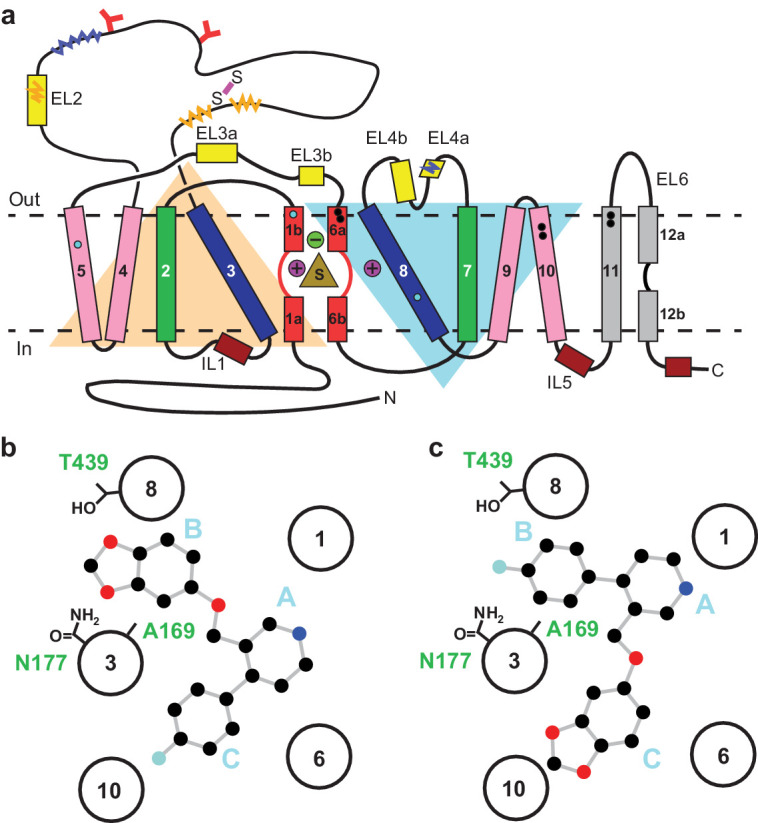
Figure 1.
Topology of SERT.
( a ) The substrate is bound at the central site (sand, triangle), near two sodium ions (purple, spheres +) and a chloride ion (green, sphere -). The light orange and light blue triangles depict pseud...
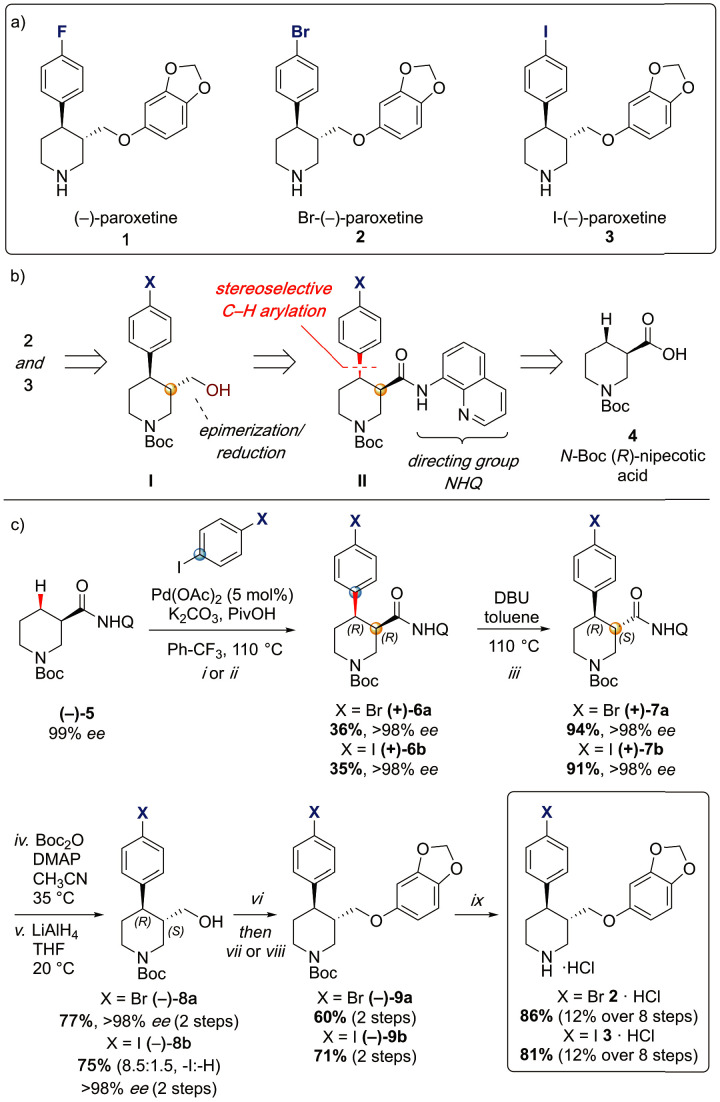
Figure 2.
Synthesis of paroxetine analogues.
( a ) Structures of (u2013)-paroxetine (1) and the targeted Br- (2) and I-analogues (3). ( b ) Retrosynthetic analysis of Br- and I-(u2013)-paroxetine. ( c ) Synthesis of Br- and I-(u2013)-paroxetine ...
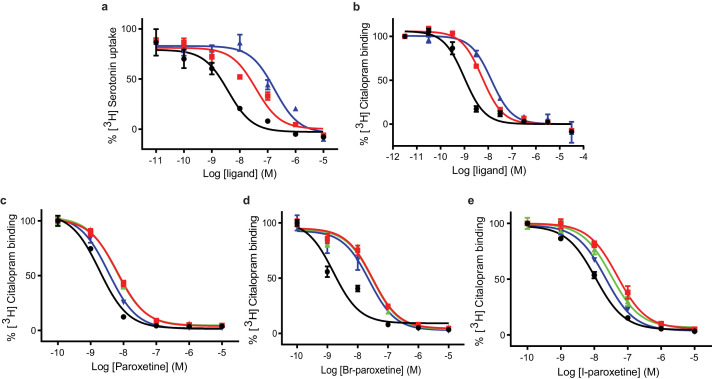
Figure 3.
Inhibition of [ 3 H]5-HT transport and [ 3 H]citalopram binding by paroxetine and the Br- and I-derivatives.
( a ) 5-HT-transport of wild-type SERT and its inhibition by paroxetine, Br-, and I-paroxetine. Data are meanu00a0u00b1u00a0s.e.m. (nu00a0=u00a06). ( b ) Competition binding of paroxetine and its deri...
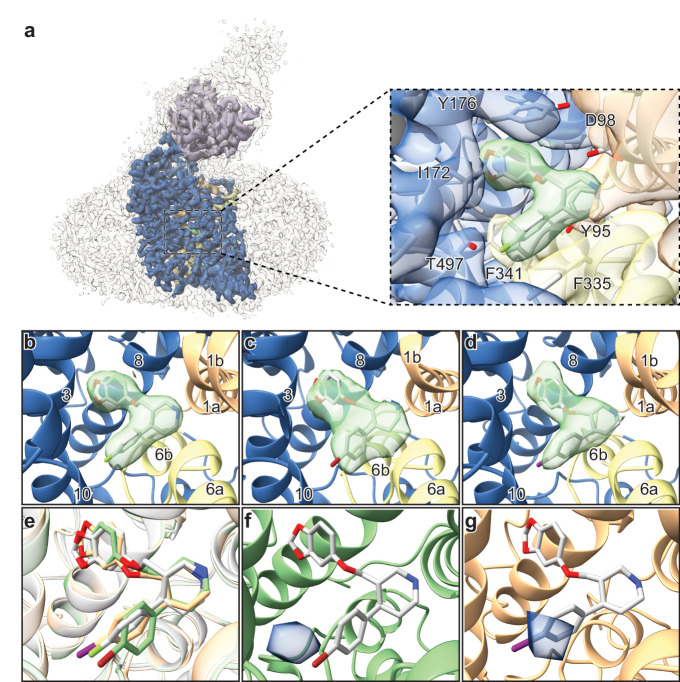
Figure 4.
Structures of SERT-paroxetine complexes.
( a ) Cryo-EM reconstruction of SERT bound to paroxetine where the shape of the SERT-8B6 Fab complex and detergent micelle is shown in transparent light grey. The density of SERT is shown in dark blue...
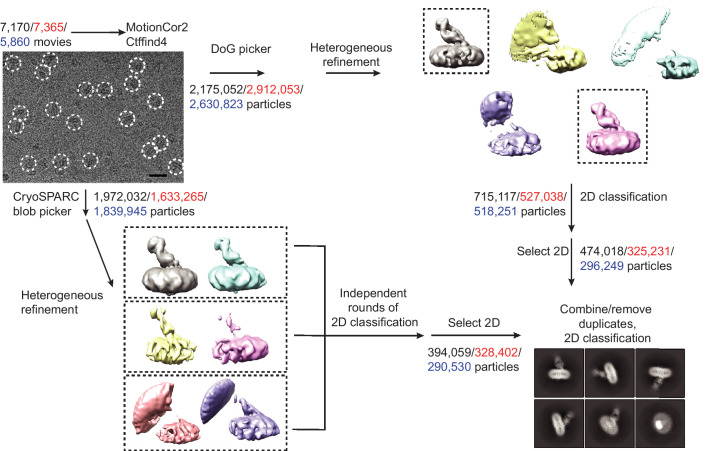
Figure 4u2014figure supplement 1.
Work-flow of cryo-EM data processing of u0394N72/u0394C13 SERT/8B6 Fab/paroxetine complexes.
A representative zoomed, motion-corrected micrograph with individual single particles circled in white. Bar equals 20 nm. Motion-correction and CTF estimation was performed using MotionCor2 and Ctffin...
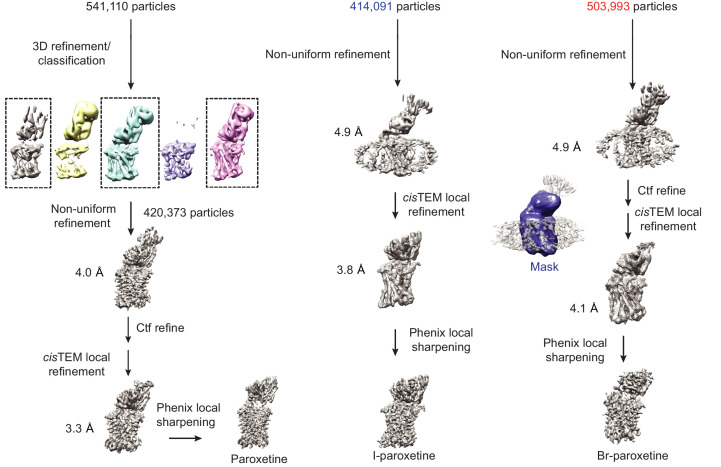
Figure 4u2014figure supplement 2.
3D refinement of u0394N72/u0394C13 SERT/8B6 Fab/paroxetine complexes.
For the paroxetine complex, 3D refinement was performed in RELION followed by 3D classification without alignment and a mask which isolated SERT and Fab. 3D classification was not performed on the Br-...
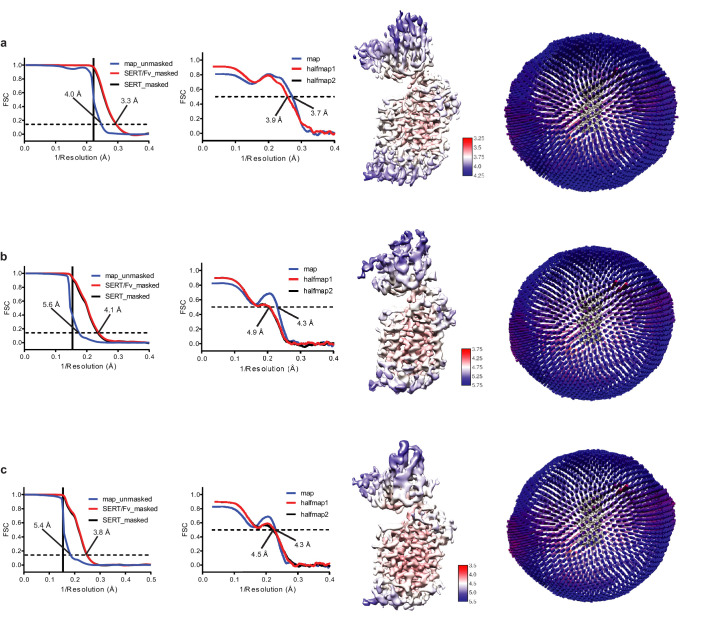
Figure 4u2014figure supplement 3.
Cryo-EM reconstruction of u0394N72/u0394C13 SERT/8B6 Fab/paroxetine complexes.
( a ) Reconstruction of SERT-8B6 paroxetine complex. Left panel, FSC curves for cross-validation, the final map (blue), masked SERT-Fv (red), and a mask which isolated SERT (black). The high-resolutio...
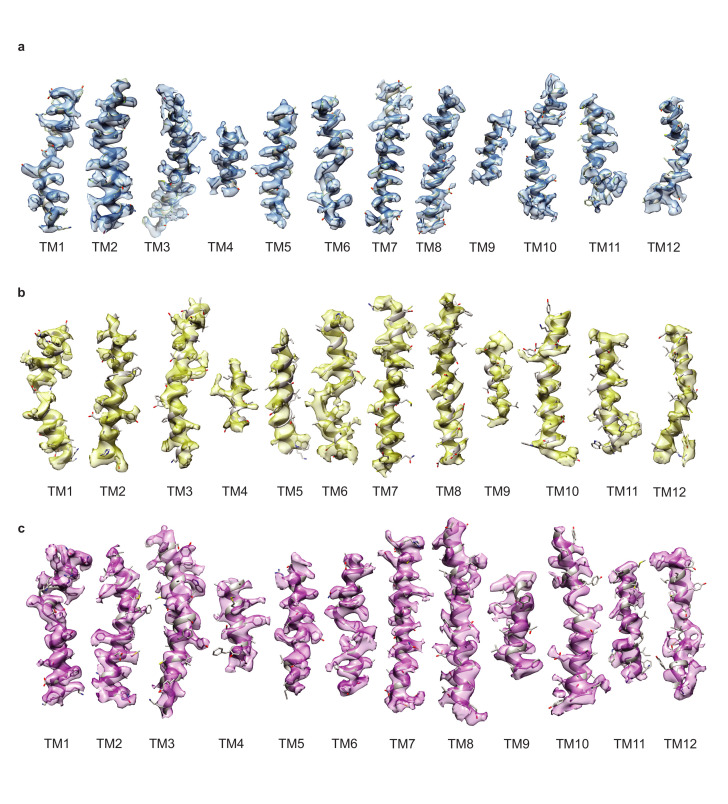
Figure 4u2014figure supplement 4.
Cryo-EM density segments of the transmembrane helices.
( a ) Density of TM1-12 of the paroxetine reconstruction, shown in blue. ( b ) Density of TM1-12 of the Br-paroxetine reconstruction, shown in yellow. ( c ) Density of TM1-12 of the I-paroxetine recon...
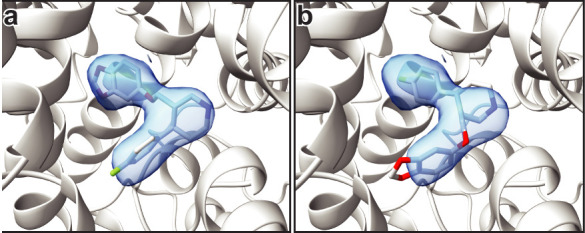
Figure 4u2014figure supplement 5.
Comparison of the fit of paroxetine in the ABC and ACB poses.
( a ) Shows the fit of paroxetine to the cryo-EM density in the ABC pose. ( b ) Shows the fit in the ACB pose.
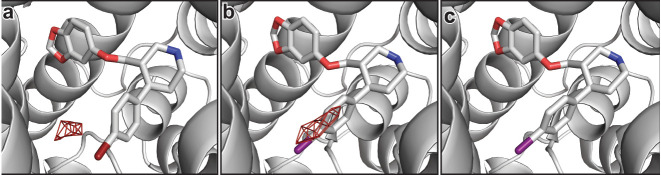
Figure 4u2014figure supplement 6.
Isomorphous difference densities at the central site.
( a ) A negative difference density feature (red mesh, 4u03c3) was observed in subsite C for the F o (paroxetine)-F o (Br-paroxetine) map. ( b ) A negative difference density feature (red mesh, 3.5u03...
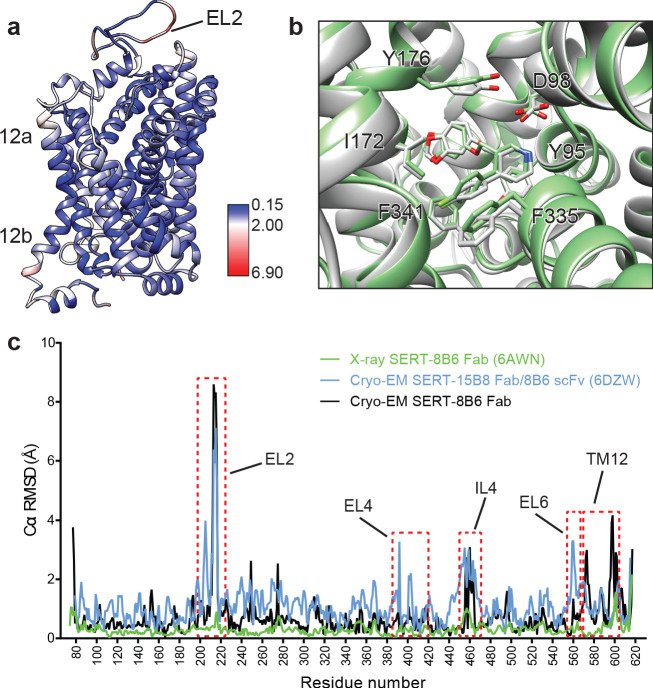
Figure 5.
Comparison of the X-ray and cryo-EM structures of the SERT-paroxetine complex.
( a ) Superposition of the x-ray ts3-SERT-8B6 paroxetine structure (PDB: 5I6X) with the SERT-8B6 paroxetine complex determined by cryo-EM. The root-mean-square-deviations (RMSD) for Cu03b1 positions w...
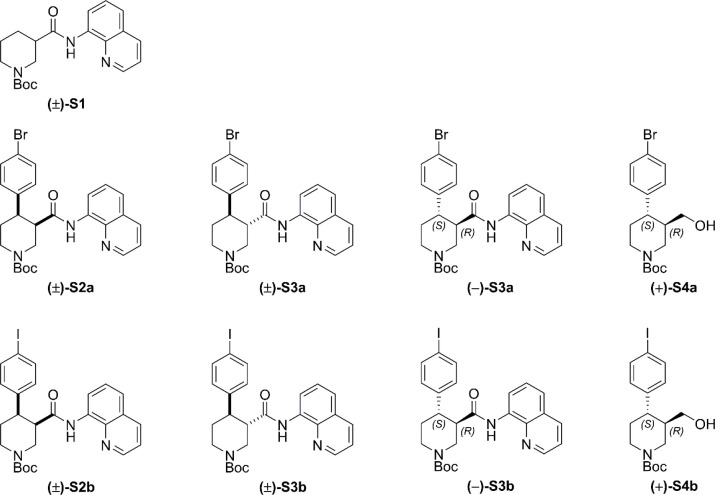
Appendix 1u2014chemical structure 1.
Full Synthetic Route to Racemic and Enantioenriched Br-Piperidine Derivatives (u00b1)-S2a, (u00b1)-S3a, (+)u22126a, (+)u22127a, (u2013)-S3a, (u2013)u22128a, (+)-S4a, (u2013)u22129a and Br-(u2013)-paroxetine 2.
In order to evaluate the enantiomeric excess of key intermediates (+)u22126a and (+)u22127a by chiral HPLC, the Cu2013H arylation with 4-bromo iodobenzene was performed on both racemic ((u00b1)-S1) an...
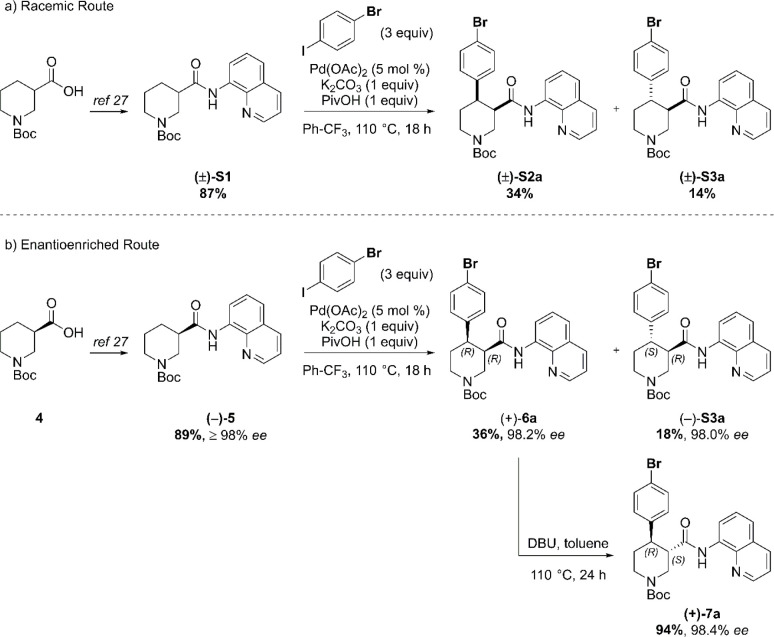
Appendix 1u2014scheme 1.
Synthetic sequence, including the Pd-catalyzed C(4)u2013H arylation step, to access racemic and enantioenriched cis- and trans- piperidine amide derivatives (u00b1)-S2a, (u00b1)-S3a, (+)u22126a, (+)u22127a and (u2013)-S3a.
( a )u00a0Cu2013H Arylation conditions: (u00b1)-S1 (0.5 mmol, one equiv) Ph-CF 3 (500 u03bcL, 1 M).u00a0( b ) Cu2013H Arylation conditions: (u2013)u22125 (4.0 mmol, one equiv), Ph-CF 3 (2.0 mL, 2 M). ...
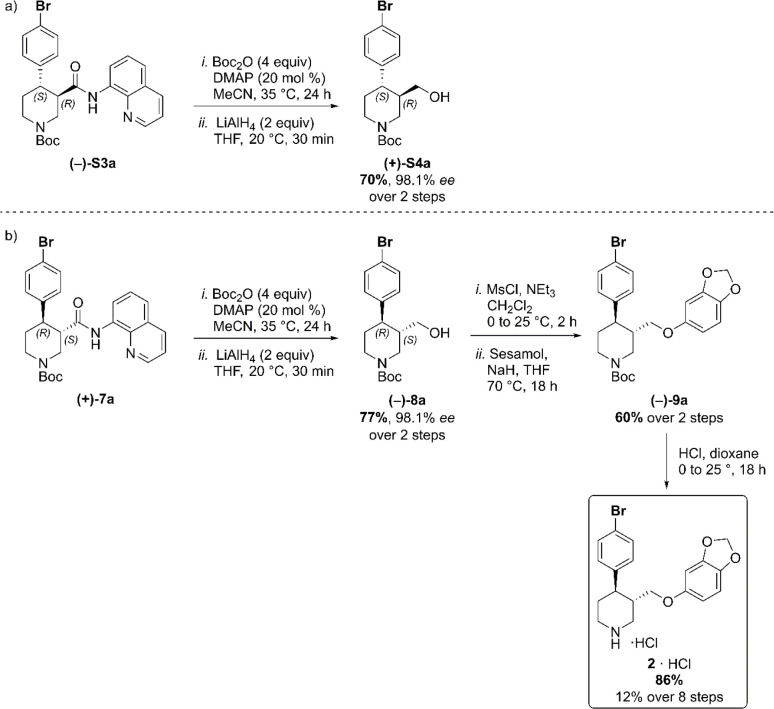
Appendix 1u2014scheme 2.
Reductive aminoquinoline removal and final steps in the synthesis of Br-(u2013)-paroxetine 2.
( a )u00a0AQ removal on enantiomerically pure trans- piperidine (u2013)-S3a (0.2 mmol, one equiv). ( b ) AQ removal on enantiomerically pure trans -piperidine (+)u22127a (1.1 mmol, one equiv) and fina...
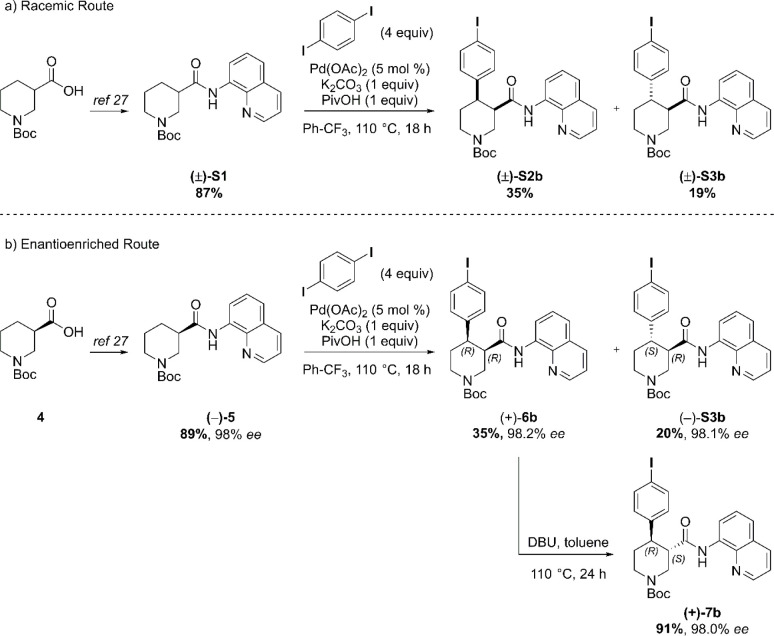
Appendix 1u2014scheme 3.
Synthetic sequence, including the Pd-catalyzed C(4)u2013H arylation step, to access racemic and enantioenriched cis- and trans- piperidine amide derivatives (u00b1)-S2b, (u00b1)-S3b, (+)u22126b, (+)u22127b and (u2013)-S3b.
( a )u00a0Cu2013H Arylation conditions: (u00b1)-S1 (0.5 mmol, one equiv) Ph-CF 3 (500 u03bcL, 1 M).u00a0( b ) Cu2013H Arylation conditions: (u2013)u22125 (4.0 mmol, one equiv), Ph-CF 3 (2.0 mL, 2 M). ...
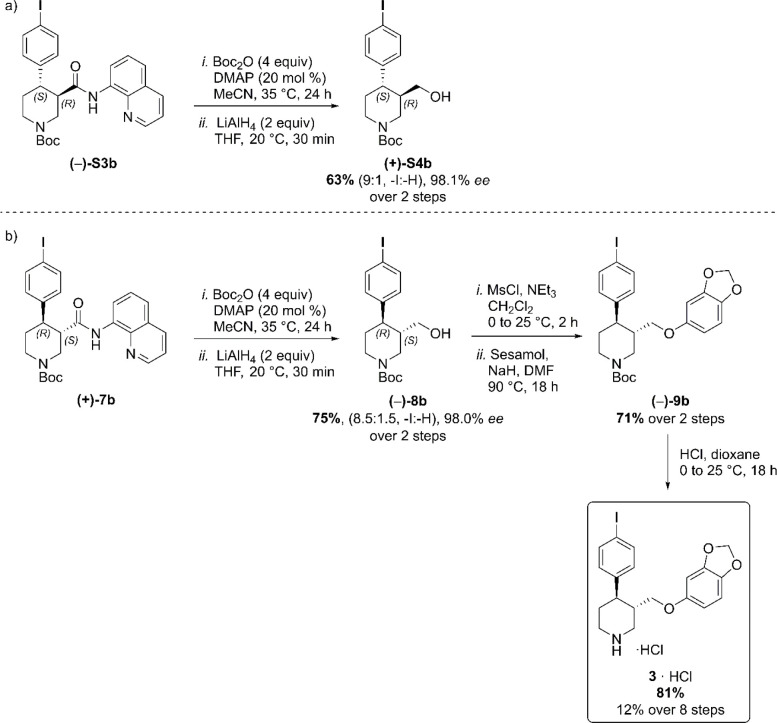
Appendix 1u2014scheme 4.
Reductive aminoquinoline removal and final steps in the synthesis of I-(u2013)-paroxetine 3.
( a )u00a0AQ removal on enantiomerically pure trans- piperidine (u2013)-S3b (0.2 mmol, one equiv). ( b ) AQ removal on enantiomerically pure trans -piperidine (+)u22127b (1.0 mmol, one equiv) and fina...
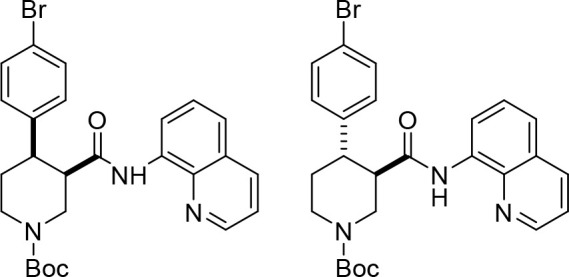
Appendix 1u2014chemical structure 2.
tert- Butyl cis- (u00b1)u22124-(4-bromophenyl)u22123-(quinolin-8-ylcarbamoyl)piperidine-1-carboxylate ((u00b1)-S2a) and tert- butyl trans- (u00b1)u22124 - (4 - bromophenyl)u22123 - (quinolin - 8 - ylcarbamoyl)piperidine - 1 - carboxylate ((u00b1)-S3a).
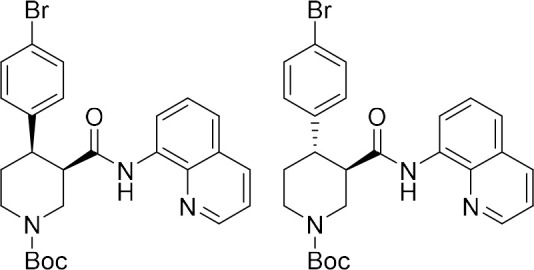
Appendix 1u2014chemical structure 3.
tert- Butyl (+)-( 3R,4R )u22124 - (4 - bromophenyl)u22123 - (quinolin - 8 - ylcarbamoyl)piperidine - 1 - carboxylate ((+)u22126a) and tert -butyl (u2013)-( 3R,4S )u22124-(4-bromophenyl)u22123-(quinolin-8-ylcarbamoyl)piperidine-1-carboxylate ((u2013)-S3a).
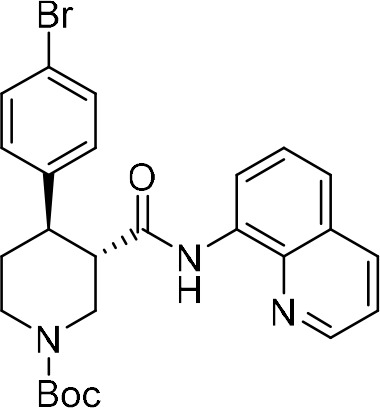
Appendix 1u2014chemical structure 4.
tert -Butyl (+)-( 3S,4R )u22124-(4-bromophenyl)u22123-(quinolin-8-ylcarbamoyl)piperidine-1-carboxylate ((+)u22127a).
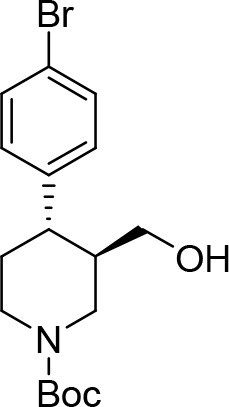
Appendix 1u2014chemical structure 5.
tert -Butyl (+)-( 3R,4S )u22124-(4-bromophenyl)u22123-(hydroxymethyl)piperidine-1-carboxylate ((+)-S4a).
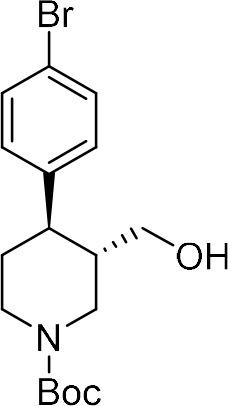
Appendix 1u2014chemical structure 6.
tert -Butyl (u2013)-(3 S, 4 R )u22124-(4-bromophenyl)u22123-(hydroxymethyl)piperidine-1-carboxylate ((u2013)u22128a).
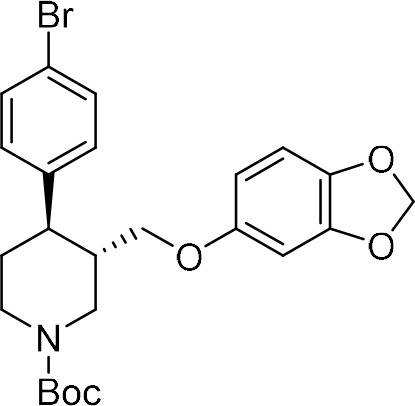
Appendix 1u2014chemical structure 7.
tert -Butyl (3 S ,4 R )u22123-((benzo[ d ][1,3]dioxol-5-yloxy)methyl)u22124-(4-bromophenyl)piperidine-1-carboxylate ((u2013)u22129a).
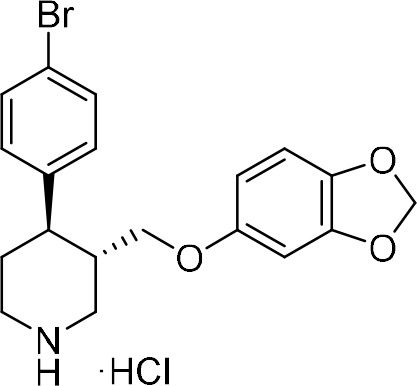
Appendix 1u2014chemical structure 8.
(3 S ,4 R )u22123-((Benzo[d][1,3]dioxol-5-yloxy)methyl)u22124-(4-bromophenyl)piperidine-1-ium chloride (2 u2219 HCl).
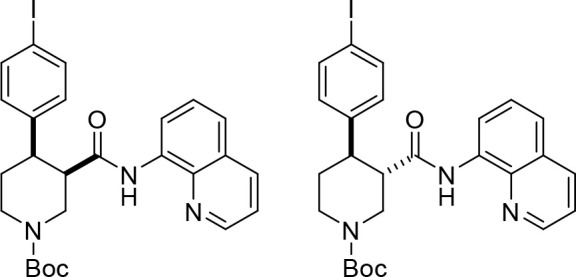
Appendix 1u2014chemical structure 9.
tert- Butyl cis- (u00b1)u22124-(4-iodophenyl)u22123-(quinolin-8-ylcarbamoyl)piperidine-1-carboxylate ((u00b1)-S2b) and tert- butyl trans- (u00b1)u22124 - (4 - iodophenyl)u22123 - (quinolin - 8 - ylcarbamoyl)piperidine - 1 - carboxylate ((u00b1)-S3b).
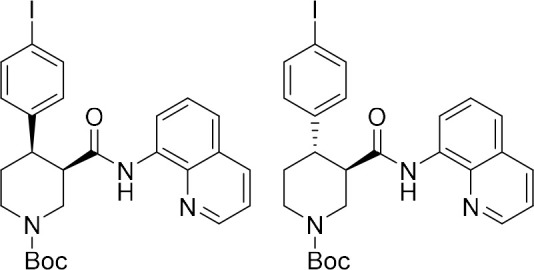
Appendix 1u2014chemical structure 10.
tert- Butyl (+)-( 3R,4R )u22124 - (4 - iodophenyl)u22123 - (quinolin - 8 - ylcarbamoyl)piperidine - 1 - carboxylate ((+)u22126b) and tert -butyl (u2013)-( 3R,4S )u22124-(4-iodophenyl)u22123-(quinolin-8-ylcarbamoyl)piperidine-1-carboxylate ((u2013)-S3b).
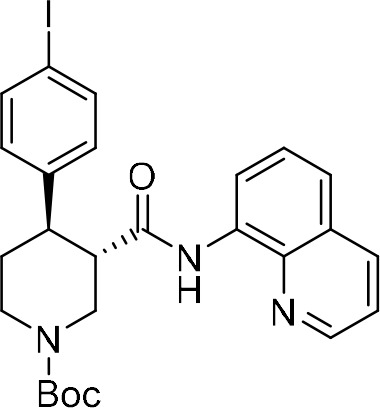
Appendix 1u2014chemical structure 11.
tert -Butyl (+)-( 3S,4R )u22124-(4-iodophenyl)u22123-(quinolin-8-ylcarbamoyl)piperidine-1-carboxylate ((+)u22127b).
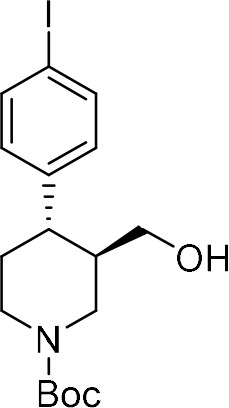
Appendix 1u2014chemical structure 12.
tert -Butyl (+)-( 3R,4S )u22124-(4-iodophenyl)u22123-(hydroxymethyl)piperidine-1-carboxylate ((+)-S4b)u00a0.
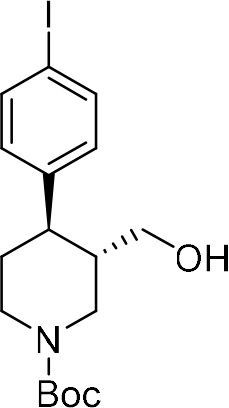
Appendix 1u2014chemical structure 13.
tert -Butyl (u2013)-( 3S,4R )u22124-(4-iodophenyl)u22123-(hydroxymethyl)piperidine-1-carboxylate ((u2013)u22128b)u00a0.
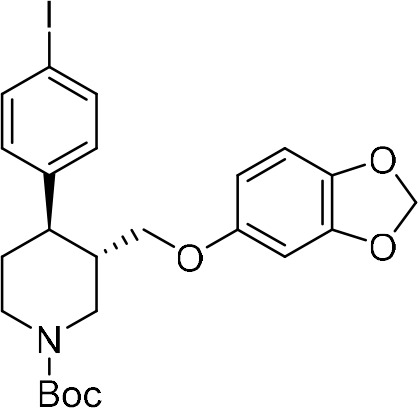
Appendix 1u2014chemical structure 14.
tert -Butyl (3 S ,4 R )u22123-((benzo[d][1,3]dioxol-5-yloxy)methyl)u22124-(4-iodophenyl)piperidine-1-carboxylate ((u2013)u22129b) Alcohol (u2013)u22128b (203 mg, 0.49 mmol, one equiv) and triethylamine (96 u03bcL, 0.69 mmol, 1.4 equiv) were added to a flame-dried round-bottom flask, dissolved in anhydrous CH 2 Cl 2 (2.5 mL, 0.2 M) and cooled down to 0u00b0C.
Methanesulfonyl chloride (49 u03bcL, 0.64 mmol, 1.3 equiv) was then added by Gilson pipette. After stirring 5 min at 0u00b0C, the reaction mixture was stirred at 25u00b0C for 2 hr, then diluted with C...
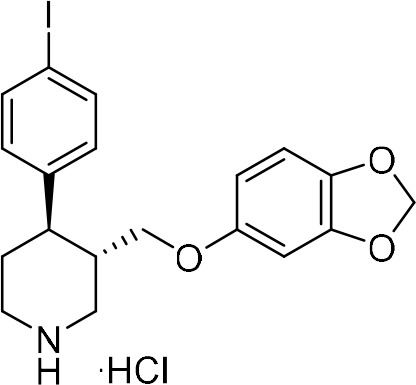
Appendix 1u2014chemical structure 15.
(3 S ,4 R )u22123-((Benzo[d][1,3]dioxol-5-yloxy)methyl)u22124-(4-iodophenyl)piperidine-1-ium chloride.
(3 u2219 HCl) 4 N HCl in 1,4-dioxane (250 u03bcL, 1.00 mmol, 10 equiv) was added to a solution of N- Boc protected piperidine (u2013)u22129b (56.9 mg, 0.10 mmol) in 1,4-dioxane (250 u03bcL, 0.4 M).u00...
Figure images are served from the NIH/NLM PubMed Central Open Access Subset or Europe PMC; copyright remains with the publishers and authors.
💬 Discussion
0 commentsNo comments yet. Be the first to start a discussion!
Leave a Comment