Abstract
The photoinduced disconnection of an oxazine heterocycle from a borondipyrromethene (BODIPY) chromophore activates bright far-red fluorescence. The high brightness of the product and the lack of autofluorescence in this spectral region allow its detection at the single-molecule level within the organelles of live cells. Indeed, these photoactivatable fluorophores localize in lysosomal compartments and remain covalently immobilized within these organelles. The suppression of diffusion allows the reiterative reconstruction of subdiffraction images and the visualization of the labeled organelles with excellent localization precision. Thus, the combination of photochemical, photophysical and structural properties designed into our fluorophores enable the visualization of live cells with a spatial resolution that is inaccessible to conventional fluorescence imaging.
🔬 Techniques
✨ Fluorophores
🔬 Cell Lines
🏭 Microscope Brands
📷 Detectors
🏛️ Research Organizations (ROR)
Affiliated research institutions:
📊 Figures
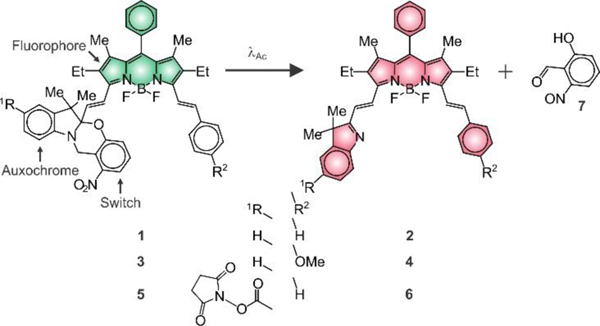
Figure 1.
Photoinduced conversion of 1 , 3 and 5 into 2 , 4 and 6 respectively.
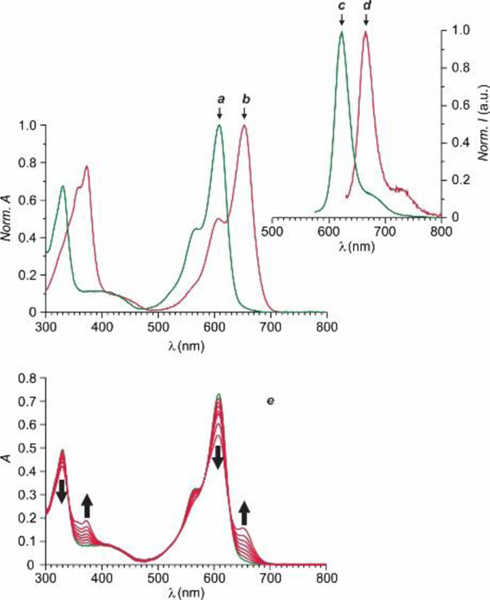
Figure 2.
Normalized absorption and emission spectra of 1 ( a and c , u03bb Ex = 565 nm) and 2 ( b and d , u03bb Ex = 620 nm) in THF at 25 u00b0C. Absorption spectra ( e ) of a THF solution of 1 (10 u03bcM) rec...
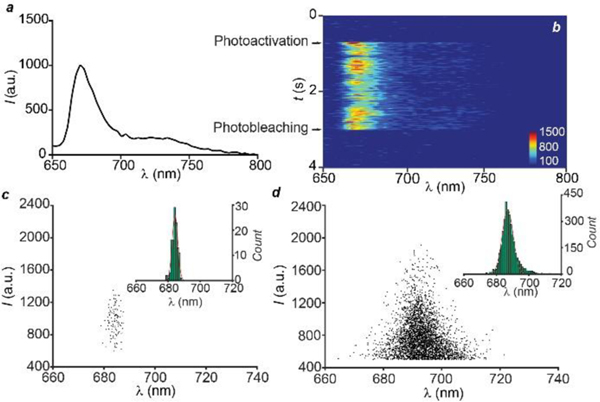
Figure 3.
Emission spectrum ( a , u03bb Ex = 642 nm), averaged over 8,971 single molecules, of a photoactivated (u03bb Ac = 405 nm) PMMA film doped with 1 and spectral evolution ( b ) of a single molecule after...
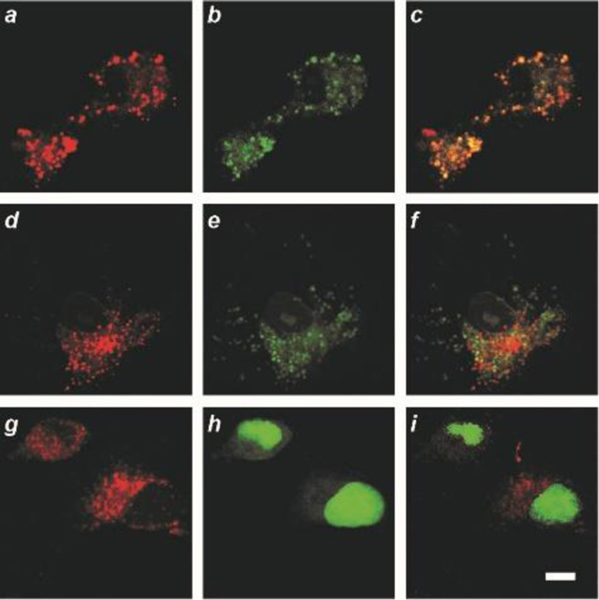
Figure 4.
CLSM images (scale bar = 10 u03bcm) of live COS-7 cells incubated with 5 ( a , d and g ; u03bb Ex = 561 nm, u03bb Em = 575u2012650 nm) and lysosomal ( b ), mitochondrial ( e ) or nuclear ( h ) stains ...
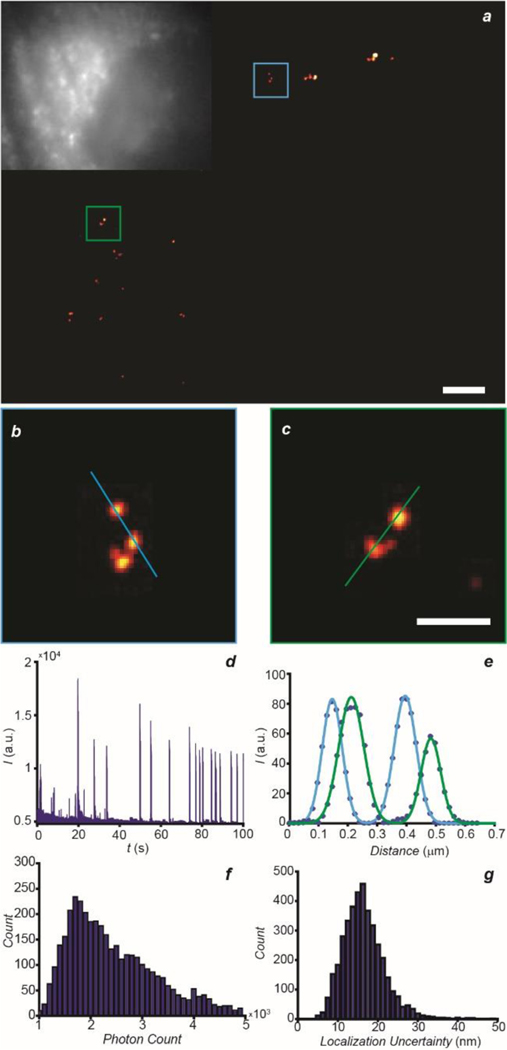
Figure 5.
PALM image ( a , scale bar = 2 u03bcm) of a COS-7 cell, labeled with 5, with magnification ( b and c , scale bar = 500 nm) of the regions highlighted in blue and green together with the corresponding ...
Figure images are served from the NIH/NLM PubMed Central Open Access Subset or Europe PMC; copyright remains with the publishers and authors.
💬 Discussion
0 commentsNo comments yet. Be the first to start a discussion!
Leave a Comment