Abstract
Reactive Oxygen Species (ROS) are known to cause oxidative damage to DNA, proteins and lipids. In addition, recent evidence suggests that ROS can also initiate signaling cascades that respond to stress and modify specific redox-sensitive moieties as a regulatory mechanism. This suggests that ROS are physiologically-relevant signaling molecules. However, these sensor/effector molecules are not uniformly distributed throughout the cell. Moreover, localized ROS damage may elicit site-specific compensatory measures. Thus, the impact of ROS can be likened to that of calcium, a ubiquitous second messenger, leading to the prediction that their effects are exquisitely dependent upon their location, quantity and even the timing of generation. Despite this prediction, ROS signaling is most commonly intuited through the global administration of chemicals that produce ROS or by ROS quenching through global application of antioxidants. Optogenetics, which uses light to control the activity of genetically-encoded effector proteins, provides a means of circumventing this limitation. Photo-inducible genetically-encoded ROS-generating proteins (RGPs) were originally employed for their phototoxic effects and cell ablation. However, reducing irradiance and/or fluence can achieve sub-lethal levels of ROS that may mediate subtle signaling effects. Hence, transgenic expression of RGPs as fusions to native proteins gives researchers a new tool to exert spatial and temporal control over ROS production. This review will focus on the new frontier defined by the experimental use of RGPs to study ROS signaling.
🔬 Techniques
🧬 Organisms
💻 Software
✨ Fluorophores
🧪 Sample Preparation
🧪 Reagent Suppliers
💻 Software Details
🏛️ Research Organizations (ROR)
Affiliated research institutions:
📊 Figures
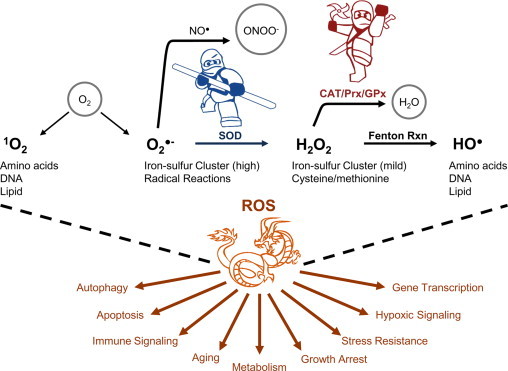
Fig. 1
ROS and their biological impact. Each ROS has intrinsic chemical properties that will render it more likely to interact with a particular biological target. The exact target of a particular ROS will d...
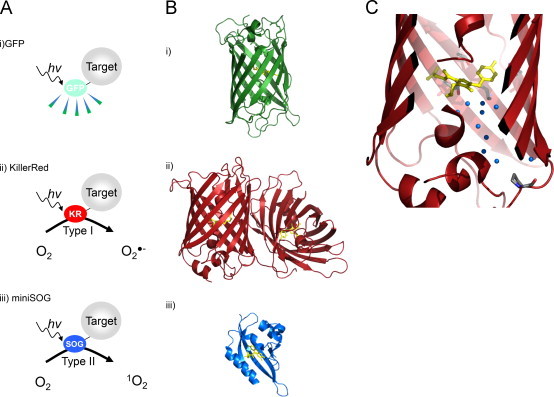
Fig. 2
Optogenetic approaches and ROS generating proteins (RGPs). (A) Unique properties of fluorescent proteins. In general, fluorescent proteins such as GFP (i) are considered inert markers. Mutations in fl...
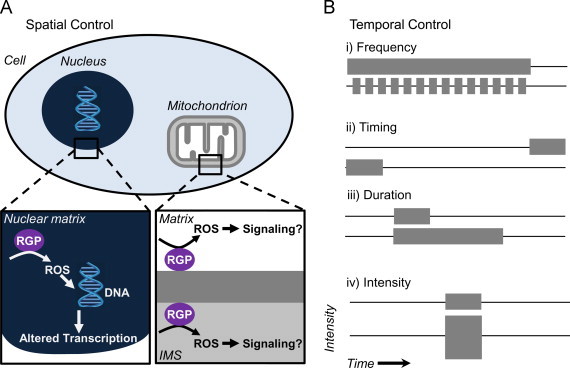
Fig. 3
Spatial and temporal control of ROS production using Optogenetics. (A) Genetically encoded RGPs allow for spatial control. An RGP can be targeted to specific sites throughout the cell such as the nucl...
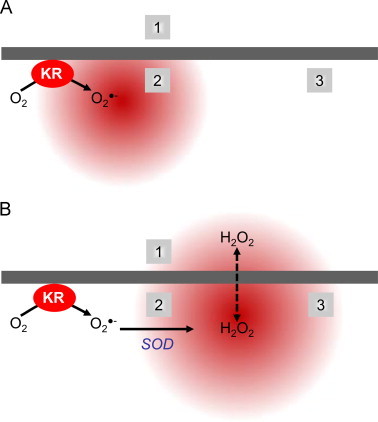
Fig. 4
ROS specific signaling microdomains. (A) Superoxideu05f3s sphere of influence. Upon illumination KillerRed (KR) generates superoxide (O 2 u2022u2212 ). The concentration of O 2 u2022u2212 can be decre...
Figure images are served from the NIH/NLM PubMed Central Open Access Subset or Europe PMC; copyright remains with the publishers and authors.
💬 Discussion
0 commentsNo comments yet. Be the first to start a discussion!
Leave a Comment