Abstract
AbstractDespite advances in low-light-level detection, single-photon methods such as photon correlation have rarely been used in the context of imaging. The few demonstrations, for example of subdiffraction-limited imaging utilizing quantum statistics of photons, have remained in the realm of proof-of-principle demonstrations. This is primarily due to a combination of low values of fill factors, quantum efficiencies, frame rates and signal-to-noise characteristic of most available single-photon sensitive imaging detectors. Here we describe an imaging device based on a fibre bundle coupled to single-photon avalanche detectors that combines a large fill factor, a high quantum efficiency, a low noise and scalable architecture. Our device enables localization-based super-resolution microscopy in a non-sparse non-stationary scene, utilizing information on the number of active emitters, as gathered from non-classical photon statistics.
🔬 Techniques
🔭 Microscopes
🏭 Microscope Brands
🎨 Filters
💻 Software Details
💾 Data Repositories
🏛️ Research Organizations (ROR)
Affiliated research institutions:
📋 Methods
Microscope setup
An optical microscope (Zeiss Axiovert 135) is used to image fluorescent samples of QDs. A two-axis piezo stage (P-542.2SL, Physik Instrumente) is used to position the sample. For illumination, a 473 nm pulsed picosecond laser diode (Edinburgh Instruments) is used, coupled to a single-mode fibre. The repetition rate of this laser is set to 20 MHz. A 1.4 numerical aperture objective lens (Plan Apo Vc 100 × , Nikon) is used to tightly focus the illuminating laser. The fluorescence is collected by the same objective lens and filtered by dichroic mirrors and filters (FF509-FDi01, SP01-785RS, BLP01-532R, Semrock). A Galilean beam expander (BE05-10-A, Thorlabs) is placed following the relay lens to magnify the imaged fluorescence spot on to a fibre bundle (A.R.T. Photonics GmbH, Germany). This fibre bundle consists of multimode 100/110 μm core/clad fibres, fused on one side and fan-out to individual multimode fibres on the other side, and is used to guide photon from an imaged spot to 15 fibre coupled single-photon avalanche photodiodes (SPCM-AQ4C, Perkin-Elemer). For a detailed characterization of the fibre bundle setup see Supplementary Note 4 . The overall detection efficiency of our setup is 12%, and further details about the efficiency are found in the Supplementary Note 1 and Supplementary Table 1 .
Data acquisition and analysis
A time-correlated single-photon counting board is used for data acquisition in absolute timing mode (DPC-230, Becker & Hickl GmbH). An excitation pulse trigger is synchronized and recorded at every 40th pulse (0.5 MHz). The correlation analysis and localization algorithms ( Supplementary Software 1 ) were implemented in a MATLAB script, postprocessing the acquired data. Further details about the algorithms are found in Supplementary Fig. 4 and Supplementary Note 5 .
Show full methods section
Microscope setup
An optical microscope (Zeiss Axiovert 135) is used to image fluorescent samples of QDs. A two-axis piezo stage (P-542.2SL, Physik Instrumente) is used to position the sample. For illumination, a 473 nm pulsed picosecond laser diode (Edinburgh Instruments) is used, coupled to a single-mode fibre. The repetition rate of this laser is set to 20 MHz. A 1.4 numerical aperture objective lens (Plan Apo Vc 100 × , Nikon) is used to tightly focus the illuminating laser. The fluorescence is collected by the same objective lens and filtered by dichroic mirrors and filters (FF509-FDi01, SP01-785RS, BLP01-532R, Semrock). A Galilean beam expander (BE05-10-A, Thorlabs) is placed following the relay lens to magnify the imaged fluorescence spot on to a fibre bundle (A.R.T. Photonics GmbH, Germany). This fibre bundle consists of multimode 100/110 μm core/clad fibres, fused on one side and fan-out to individual multimode fibres on the other side, and is used to guide photon from an imaged spot to 15 fibre coupled single-photon avalanche photodiodes (SPCM-AQ4C, Perkin-Elemer). For a detailed characterization of the fibre bundle setup see Supplementary Note 4 . The overall detection efficiency of our setup is 12%, and further details about the efficiency are found in the Supplementary Note 1 and Supplementary Table 1 .
Data acquisition and analysis
A time-correlated single-photon counting board is used for data acquisition in absolute timing mode (DPC-230, Becker & Hickl GmbH). An excitation pulse trigger is synchronized and recorded at every 40th pulse (0.5 MHz). The correlation analysis and localization algorithms ( Supplementary Software 1 ) were implemented in a MATLAB script, postprocessing the acquired data. Further details about the algorithms are found in Supplementary Fig. 4 and Supplementary Note 5 .
QDs and sample preparation
Samples of CdSe/CdS/ZnS colloidal QDs 19 were prepared by spin coating a low concentration solution mixed with poly(methyl methacrylate) on a microscope coverslips. Fluorescence from the these QDs peaks at 610 nm, with a lifetime of 26 ns.
Data availability
The raw data that support the findings of this study are available in figshare repository with the identifier doi:10.6084/m9.figshare.4588723.v1 (ref. 42 ).
Supplementary Material Supplementary Information Supplementary Figures, Supplementary Table and Supplementary Notes. Supplementary Software 1 This software package contains the algorithms for calculating g^(2), thresholding single-emitter events and the localization algorithm used in the manuscript.
📊 Figures
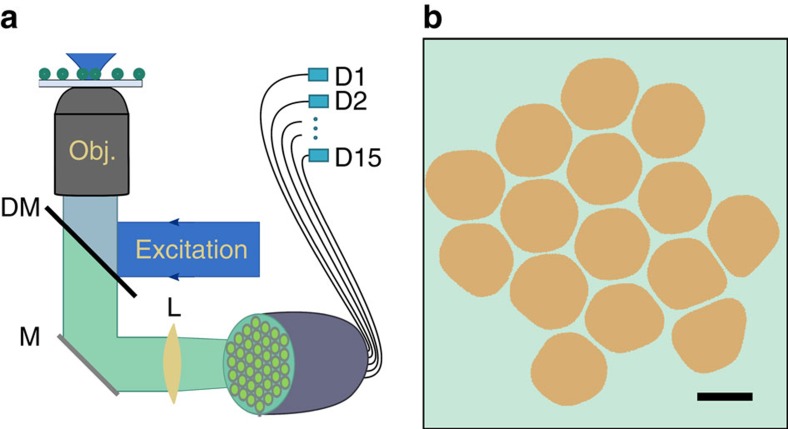
Figure 1
Measuring quantum correlations in a confocal microscope.
( a ) Schematic of a single-photon fibre bundle camera (SFICAM) with 15 single-photon avalanche detectors (SPADs). ( b ) Cross-section of the fibre bundle. This segmented image was compiled by thresho...
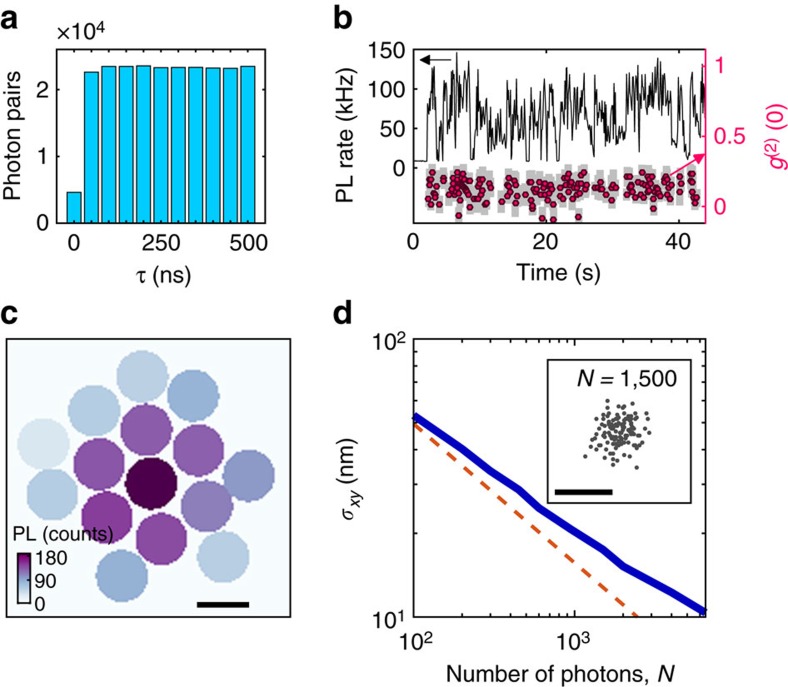
Figure 2
Localization of a single emitter using a fibre bundle.
( a ) Two-photon correlation count and ( b ) photoluminescence (PL) count rate (black line), summed over all detectors, and quantum correlation (red dots), summed over all detector pairs, for a single...
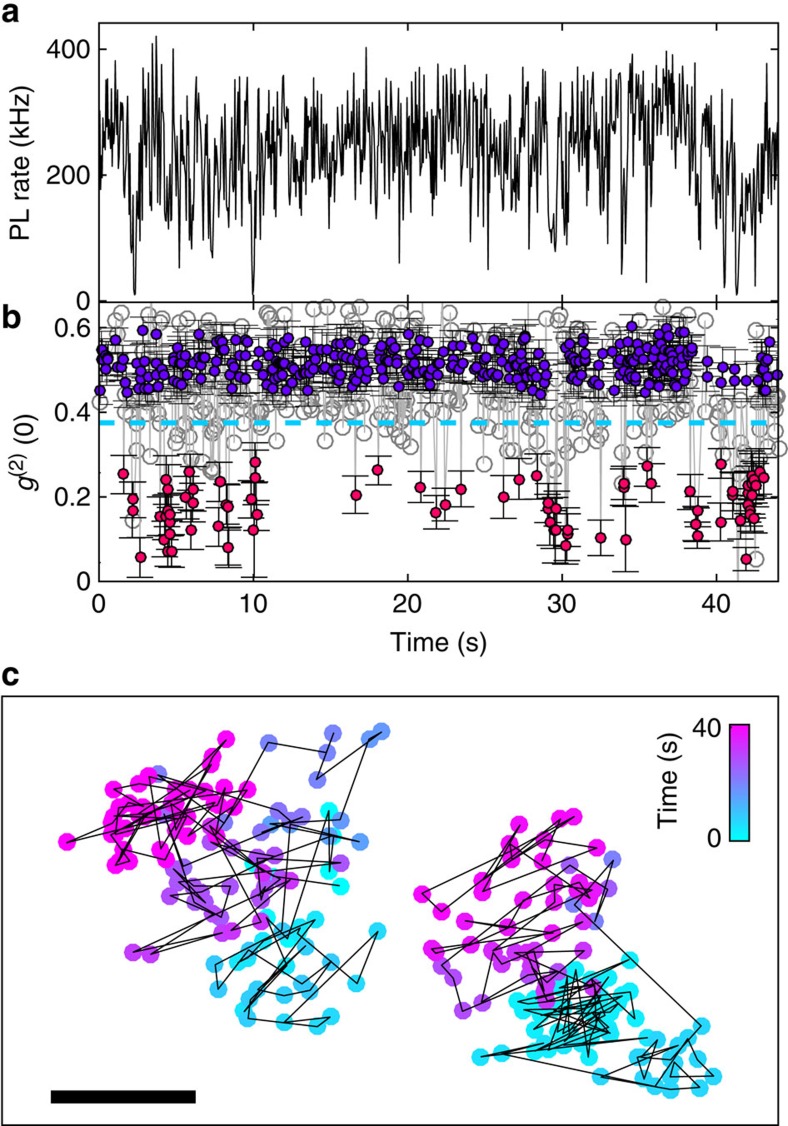
Figure 3
Super-resolution localization and single-particle tracking using quantum correlations of two emitters undergoing drift.
( a ) Photon count and ( b ) quantum correlation for two quantum dots (QDs). Blinking of one QD results in antibunching, g (2) (0)u22480, shown in red. Instances where more than one emitter is blinked...

Figure 4
Localization of two QDs with different post-selection criteria.
( a ) Used all photon counts, ( b ) used a photon count rate threshold of the lowest 10% intensity periods and ( c ) used the single-emitter antibunched photon counts (as in Fig. 2c ). All localizatio...
Figure images are served from the NIH/NLM PubMed Central Open Access Subset or Europe PMC; copyright remains with the publishers and authors.
💬 Discussion
0 commentsNo comments yet. Be the first to start a discussion!
Leave a Comment